A store cannot close to count. A count that happens in pieces, alongside trading, is what keeps a retail record current — and its design is about scope and rhythm, not speed.
01 / FIELD NOTE
Keep the decision tied to the operating context.
A warehouse can close for a count. A shop generally cannot, or can only do so at a cost that makes the exercise hard to justify. That single constraint is what shapes retail counting: it has to be done in the presence of shoppers, around trading, and in pieces small enough that no one notices it happening.
Cycle counting as a method already assumes this. Rather than one comprehensive count, a small area is counted regularly and the whole estate is covered over a cycle. The advantage is not that the work is smaller in total but that it is distributed, and that a discrepancy is found while the events that caused it are recent enough to identify. A count taken six months after the fact can only be written off.
What bulk reading changes is the unit of counting. When a whole rail, a shelf bay or a stockroom section can be captured in one pass, the natural unit becomes the area rather than the item, and an area can be slotted into a quiet fifteen minutes. That is what makes a daily or weekly rhythm realistic in a shop, and the rhythm is what keeps the record current.
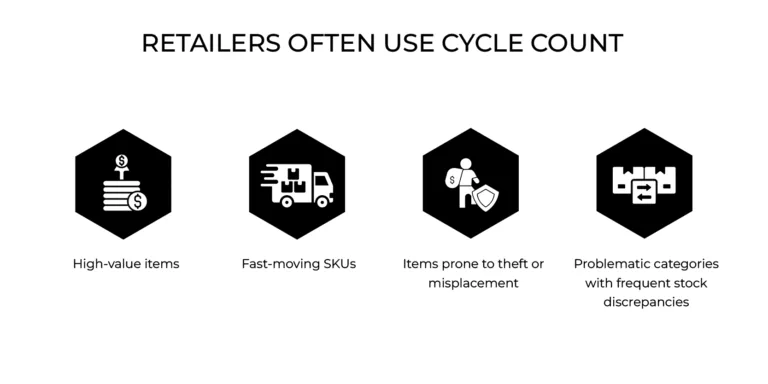
Scope should follow the store’s own risk rather than being uniform. High-value categories, fast-moving lines, and the products most exposed to misplacement warrant more frequent counting than a wall of accessories that never moves. Counting everything on the same schedule spends effort uniformly on a problem that is not uniform.
The read position is what makes successive counts comparable. A count taken while walking down an aisle varies with pace and angle; a count taken from a defined position, facing a defined direction, at a defined power setting, can be compared with the last one. Since the value of a cycle count comes from comparing successive results, reproducibility matters more than maximum reach.
Coverage gaps should be mapped rather than assumed. A test at the start — placing known tags through the area and reading from the intended position — establishes which parts of the rail or shelf are reliably read and which are shielded. That map is the difference between a count whose blind spots are known and one where a gap in coverage is indistinguishable from missing stock.
The exception categories are the count’s actual output. Expected and not read suggests an item that moved without being recorded, an unreadable tag, or a coverage gap. Read but not expected suggests a sale or transfer that was never posted. Read in the wrong place identifies misplacement directly. Each points somewhere different, and averaging them into one variance destroys the information.
Stock that is present but should not be counted has to be excluded deliberately. Goods staged for an online order, items already picked for collection, returns awaiting processing — all are physically in the area and none belong in a count of available stock. A read zone that cannot exclude them will report them as unexplained surplus, and the staff will learn to disregard the exceptions.
The trading day sets the practical limits. A count that requires moving fixtures, opening every drawer or disturbing a display will not be done regularly, whatever the plan says. The design question is what can be captured without disturbing what a shopper sees — which usually means counting behind the scenes more often than on the shop floor, and treating the floor as a periodic exercise.
The results have to reach someone who can act. A count that produces an exception queue nobody clears is a cost with no benefit, and the team will revert to counting the way it did before. Assigning the queue to a named role, even a shared one, and making the resolution visible is what keeps the practice alive after the initial attention has moved on.
Replenishment and the sales floor are the eventual consumers of the count. A current record is what allows a size to be found for a shopper, a collection order to be assembled with confidence, and a replenishment task to be directed rather than searched for. The count is not the benefit; the decisions it enables are, and the design should be judged on whether those decisions get better.
The measure of a retail counting programme is not the accuracy of any single count. It is whether the count happens often enough to matter, whether an exception can be traced to a cause, and whether the staff use the resulting figure rather than a private tally. A programme that produces an accurate annual number has reproduced the old method at greater expense.
02 / FITTING IT INTO TRADING
Small areas, frequent passes.
- The area rather than the item as the counting unit
- A defined read position so successive counts are comparable
- A coverage test that maps where the reads are weak
- Counting behind the scenes more often than on the floor
03 / WHAT THE EXCEPTIONS MEAN
Each points somewhere different.
- Expected and not read: unrecorded movement, a bad tag, or a coverage gap
- Read but not expected: a sale or transfer never posted
- Read in the wrong place: misplacement, identified directly
- An owner for the queue, or the practice decays
Bring the item, material, movement, target read and system context to a sample or project review.
Request a sample test