
INVENTORY / COUNT AND RECONCILE
RFID inventory management systems
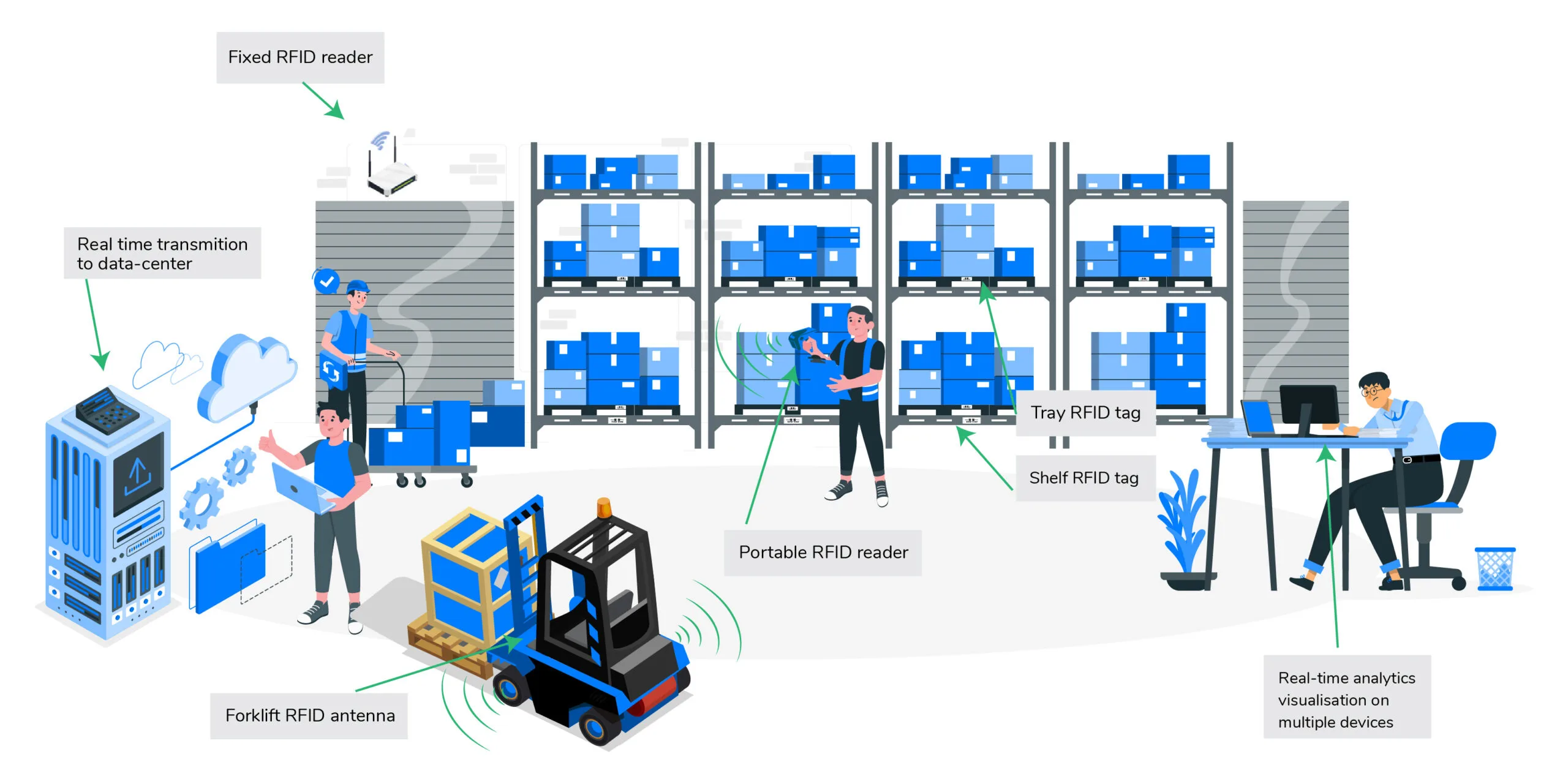
Count, locate and reconcile inventory without turning every movement into a manual scan.
Explore this solutionConnect item identity, reader events and business systems with an RFID workflow designed around the way your operation actually moves.
01 / WHAT AN RFID SOLUTION DOES
An RFID solution is more than a tag or reader. It connects a physical item to a defined observation, a business rule and the system or person responsible for the next action.
That means the project starts with the item, material, movement and exception path. Hardware and software are selected after the read boundary is understood and tested with representative samples.
02 / SOLUTIONS BY OPERATING PROBLEM
These solution paths are starting points for different operating decisions. Open the detailed brief to review workflow, equipment, integration, testing and deployment considerations.
INVENTORY / COUNT AND RECONCILE
Count, locate and reconcile inventory without turning every movement into a manual scan.
Explore this solution WAREHOUSE / RECEIVE AND MOVE
Turn receiving, put-away and cycle counts into faster, more observable warehouse workflows.
Explore this solution
ASSETS / FIND AND HAND OVER
Know what is available, where it was last seen and which team owns the next action.
Explore this solution
RETAIL / ITEM-LEVEL VISIBILITY
Improve item-level visibility across stockrooms, sales floors and fulfillment operations.
Explore this solution
MANUFACTURING / TRACE THE PROCESS
Connect material, work order and station events without relying on paper travelers.
Explore this solution
HEALTHCARE / ACCOUNT FOR SUPPLIES
Make mobile equipment easier to find while keeping staff workflow and data handling in view.
Explore this solution03 / THE SOLUTION METHOD
A dependable RFID workflow is designed as a chain. Each step produces a decision or evidence for the next one.
Record surface, shape, material, attachment and the identity level the operation needs.
Define where the observation should happen, what should be ignored and how an operator receives feedback.
Map identity, location, time and direction to a business event with an owner for exceptions.
Test normal and unwanted cases with representative items before a wider rollout or volume order.
04 / DESIGN FOR THE REAL ENVIRONMENT
RFID performance depends on the relationship between tag, reader, antenna, material, movement and software. A product category alone cannot answer that question.
Fit the physical combination to the item and the read boundary.
Measure the workflow with representative materials, operators and movement.
Give the receiving system enough context to act and recover.
05 / MORE APPLICATION PATHS
Some projects begin with a shared tool, a returnable container or a product identity. These routes apply the same evidence-first method to a different operating context.
Reduce tool search time and create a dependable handover record for teams in the field.
Track pallets, totes and containers through circulation, return and maintenance.
Give products, packaging and channel events a traceable identity that can be verified.
06 / 54 DETAILED SOLUTION PAGES
Every application below has its own crawlable page with a real workflow image, event model, operating boundary, first-review questions and validation plan. These are starting points for a sample test, not promises that one configuration fits every site.
Use a reviewed count and replenishment workflow for supplies while limiting the data collected to what operations need.
Turn a physical count, receipt or reconciliation into an observable event that can be checked before the system record changes.
Reconcile stock assigned outside the central store by combining item identity, location or custodian context and a reviewable count event.
Organize identity, storage movement and exception review for materials whose handling conditions need explicit operational control.
Use RFID as a controlled data-capture method for stock, material and location counts that need reviewable exceptions.
Connect the item or case identity to receiving, storage, issue and review events where the operating process requires traceable movement records.
Capture receiving, storage and issue events for cases, ingredients or reusable units in a bounded operating workflow.
Use controlled receiving, transfer and count events to make pallet, carton and location status reviewable in the warehouse system.
Connect receiving, staging, storage, loading and return events to a controlled warehouse or distribution process.
Verify a defined inbound or outbound load at the dock without confusing adjacent staging or reverse movement with the intended event.
Apply a controlled receiving, storage and movement workflow to goods handled in cold or moisture-prone environments.
Connect linen, carts, service equipment and supply circulation to the property area or team that owns the next handoff.
Keep an accountable record for shared equipment, spares and maintenance assets as they move between storage, field and service areas.
Give shared equipment a durable identity and a last-seen, handover or service event that the responsible team can act on.
Track garments and linen through issue, collection, cleaning, return and shortage workflows with a defined unit of accountability.
Keep handling equipment, reusable tools and shared assets connected to their custodian, location and service status within the warehouse.
Link laptops, peripherals and shared devices to assignment, return, location and service workflows without making unsupported configuration claims.
Maintain a reviewable record for equipment movement, rack-area custody and service activity in controlled technical spaces.
Organize equipment, material and location handoffs across demanding operational areas with a clear owner for each exception.
Track shared equipment through issue, field presence, inspection, return and service workflows that remain accountable to operations.
Create a practical last-seen and handover record for assets moving between field locations, vehicles, crews and support areas.
Use controlled yard entry, storage, issue and return events to make equipment movement more reviewable.
Track shared tools, fixtures and production-support assets through issue, location, service and return activities.
Maintain an accountable asset record across offices, stores, field teams and service workflows using defined identity and handover events.
Support controlled equipment and inventory handoffs where the responsible organization needs clear custody, access and exception records.
Track shared equipment and materials between facilities, departments and field teams with a practical custodian and recovery workflow.
Coordinate mobile equipment, linen, supplies and event assets through high-circulation issue, return and readiness workflows.
Manage garment and linen circulation with a clear identity, issue and return event, and an accountable readiness state.
Track shared devices, learning equipment and facilities assets through assignment, return, storage and service workflows.
Make school-owned devices and shared equipment easier for authorized staff to issue, locate, return and service.
Connect equipment, lab assets and shared devices to departmental custody, location and maintenance events across a campus.
Use item-level identity to make stockroom, sales-floor and fulfillment counts easier to compare with the retail record.
Connect item identity with store counts, replenishment and fulfillment decisions in a repeatable retail operating route.
Make merchandise and material counts visible across the stockroom, selling floor and defined back-of-house handoffs.
Use container or signal identity to make a replenishment trigger visible between the point of consumption and the supplying team.
Capture a controlled transition for material, work order or container identity at a station, buffer or quality handoff.
Make work-unit movement between stations and buffers visible while preserving the process owner's approval and exception rules.
Make shared instruments and kits easier to locate, issue, return and hold for service inside a defined laboratory workflow.
Frame equipment, supply and controlled-service workflows around the staff action and approved operational system that need the event.
Track a defined set through preparation, issue, return and service states without assuming an observation confirms readiness.
Connect instrument identity, storage location, user handoff and maintenance hold to the laboratory workflow that owns availability.
Help authorized teams locate mobile equipment and review return, service and availability exceptions across defined departments.
Record the handoff of tools, material units or reusable components between yards, crews and project zones.
Track durable tools and IT equipment through assignment, return, maintenance and overdue recovery workflows.
Validate that a defined component reaches the intended site, work area or handover rather than relying on a nearby read alone.
Make issue, return, inspection and overdue steps visible for tools shared by a workshop, vehicle, crew or field team.
Connect product, kit or case identity to controlled packaging, stock and channel-check events without treating a tag read as proof on its own.
Use serialized unit or pack identity to support controlled production, distribution and investigation records for electronic goods.
Associate product or case identities with defined packaging and channel checkpoints when a verification workflow is required.
Support controlled identity and verification checkpoints for packaged items while keeping operational records separate from sensitive data.
Pair serialized identity with controlled issuance, channel checks and an investigation process for high-value goods.
Use a close-range identity interaction where a product or package needs a deliberate verification checkpoint.
Track pallets, totes, containers or other circulating assets through dispatch, receipt, return and maintenance across a defined pool.
Track reusable rental items through dispatch, customer or site handoff, return, inspection and maintenance events.
RFIDBRIDGE / NEXT STEP
Tell us what needs to be identified, where it moves and what system should receive the event.
Request a project quote