Retail and apparel
Item visibility, store counts and omnichannel availability.
01 / THE QUESTION
Where does
visibility break?
Item visibility, store counts and omnichannel availability. RFID becomes valuable when it reduces a specific handoff, search, count or verification problem and puts a trusted event into the right system.
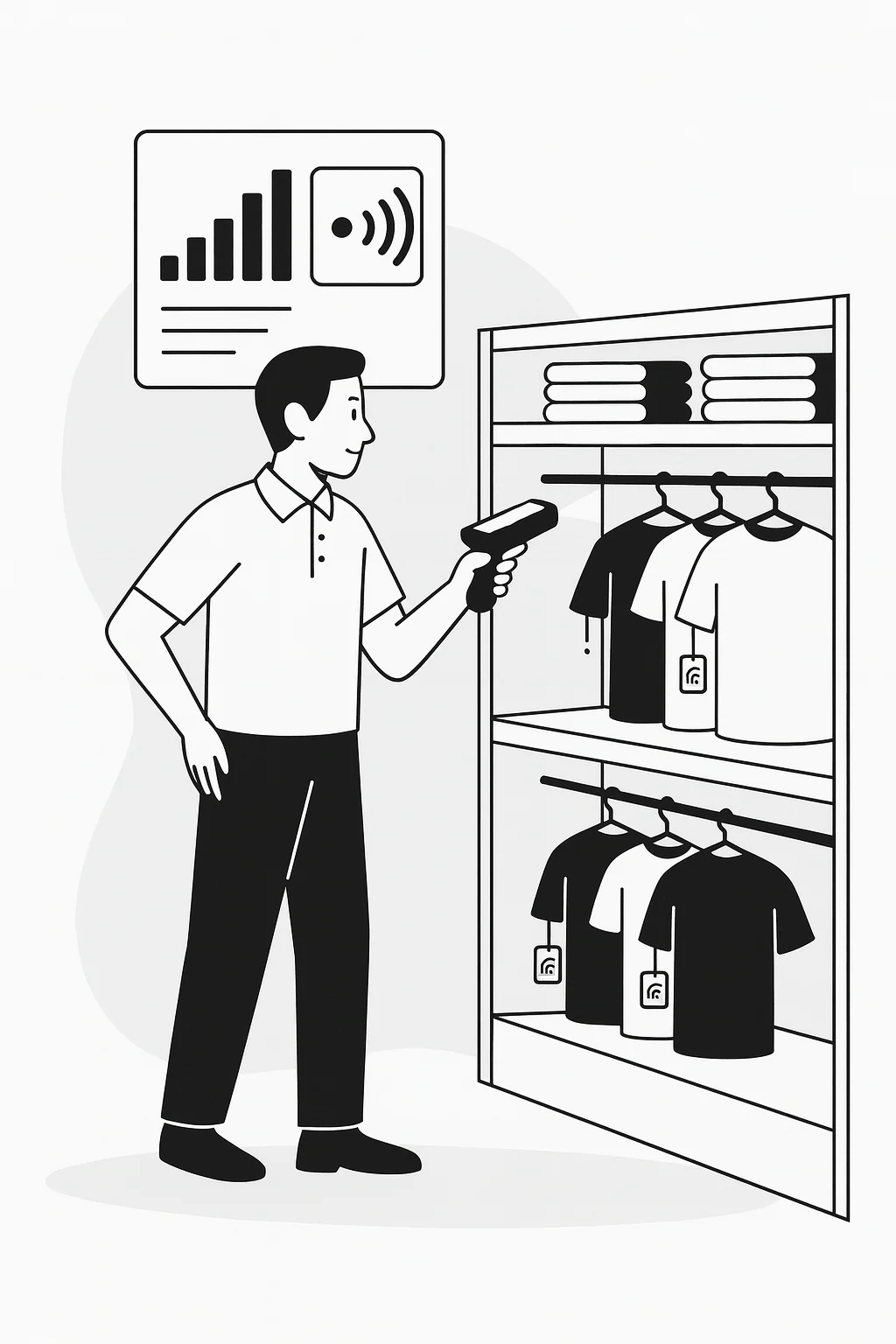
FIELD VIEW / ITEM IDENTITY
Keep each item
easy to account for.
Retail and apparel RFID can connect item, store and fulfillment events when the tag construction, count method and exception workflow are tested together.
- Identify garments, accessories or stock units at defined handoffs
- Capture receiving, count, transfer and fulfillment events
- Test tag placement, item density and operator handling on representative merchandise
02 / INDUSTRY WORKFLOW
Four moments.
One accountable handoff.
Improve item-level visibility across stockrooms, sales floors and fulfillment operations. The sequence below is specific to the operating environment and remains subject to representative testing.
Create item identity
Associate the item-level identifier with style, size, color and the packaging level owned by the retail system.
Count the store route
Run stockroom and sales-floor counts using a repeatable operator route that includes dense racks and fixtures.
Compare availability
Separate observed items from the availability decision so a discrepancy can be reviewed before replenishment.
Fulfill or replenish
Pass the accepted item and location state to the inventory or order workflow that owns the next action.
03 / INDUSTRY-SPECIFIC SCOPE
Make the material
and risk explicit.
Industry context changes the test. These are the details to carry into the first sample, site survey or proof of concept.
Read the planning guideHanging and folded merchandise, stockroom locations, store fixtures and fulfillment units.
Dense items, changing presentation and a count process that adds friction to store work.
Compare expected and observed items across a defined store route, including replenishment exceptions.
04 / RELATED SOLUTION
Start with the
operating workflow.
The retail handoff should preserve item identity, store, location, count time and discrepancy status for inventory or fulfillment review.
05 / PROJECT REVIEW
Prove one
repeatable moment.
Use the related solution to frame the workflow, then validate the material, environment and exception path against representative samples.
- Define the acceptance target
- Test the item and environment
- Train the people who own the exception
- Scale only after the workflow is usable