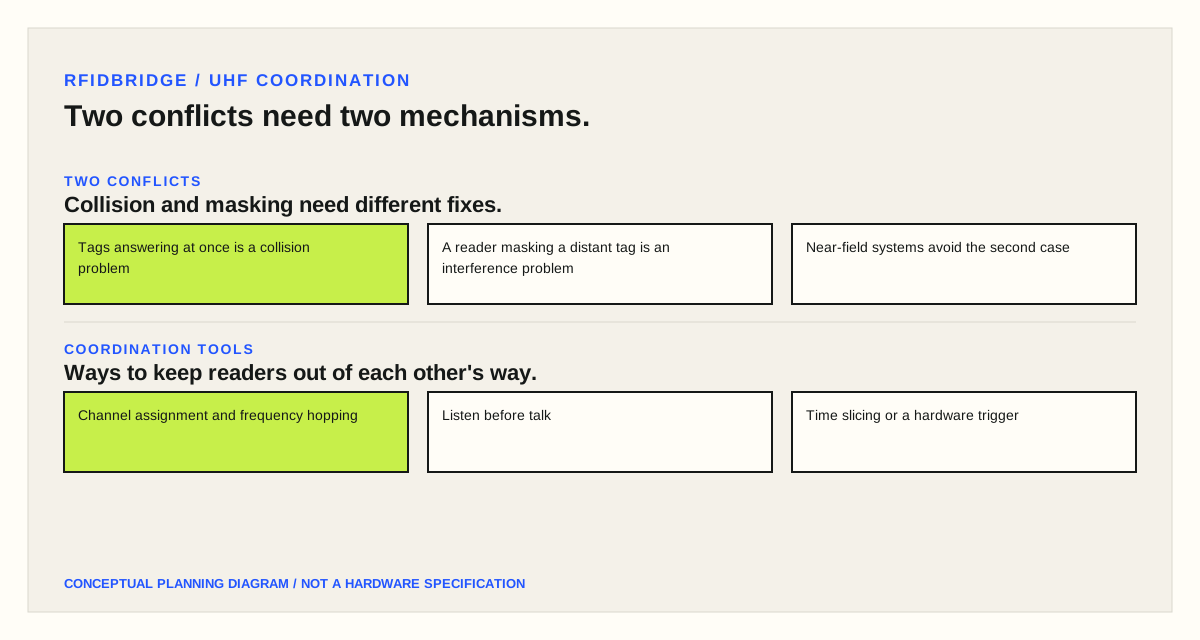
Tag-to-tag collision and reader-to-reader interference are separate problems with separate mechanisms; Gen2 addresses the first with anti-collision and the second with reader operating modes.
01 / FIELD NOTE
Keep the decision tied to the operating context.
Two things are called interference in an RFID system, and they have almost nothing in common. Tag-to-tag interference is a collision: several tags answer at once and the reader cannot separate their replies. Reader-to-reader interference is a masking effect: one reader transmitting drowns out the much weaker reply another reader is trying to hear. The first is handled by anti-collision, the second by reader operating modes.
The scale difference explains why the second problem exists at all. A reader transmits with enough power to energise a passive tag at a distance, while the tag answers by reflecting a small fraction of that energy back. The two signals share a channel and the reader transmission is enormously stronger than the reply, so a reader that is far away but transmitting can mask a tag that is close by.
Near-field systems are largely spared the reader-to-reader case. Low and high frequency readers couple to tags through magnetic flux, which falls away very quickly with distance, so two readers that are not physically adjacent do not disturb each other. The problem belongs to UHF and microwave systems working in the far field, where energy propagates and carries across a site.
Gen2 defines reader operating levels by how many readers are active relative to the channels available. When fewer readers are transmitting than there are channels, a multiple-reader environment results and interference is avoidable by assigning channels or by dividing time. When active readers outnumber available channels, the environment is dense, and every reader in it has to be operating in dense-reader mode for the scheme to work at all. One reader left in a non-dense mode can undermine the arrangement for the others.
Dense-reader mode separates readers and tags in how they may use the available channels, so a strong reader transmission does not arrive on top of a weak tag reply. The channel counts differ by region — the United States allocates around fifty channels in the 902–928 MHz band while Europe has fewer — which is why a dense installation designed in one region does not transfer unchanged to another.
Three techniques are commonly combined. Frequency hopping moves a reader through a set of channels on a schedule, which spreads the interference across the band rather than concentrating it; the rules for a region set both the channel width and how long a reader may stay on one channel before moving. Listen before talk has the reader check the channel it is about to use and defer if another reader is already transmitting. Time slicing hands control to a coordinating system that gives each reader a defined window and turns it off when the window closes.
Hardware timing achieves the same result with less coordination overhead. A trigger device starts a read cycle when an item breaks a beam entering the zone and stops it when a second beam is broken on the way out, so the reader transmits only while there is something to read. In a workflow that already has a physical gate or a defined handover point, this is often the cheapest way to keep neighbouring zones from overlapping in time.
Tag collision is a different problem with its own solutions, and they divide into deterministic and probabilistic families. A deterministic scheme, such as a binary-tree or tree-walking algorithm, asks for successive bits of the tag identifier and lets only tags matching the request so far reply. It narrows the population step by step, which is slower per round but converges without relying on chance. A probabilistic scheme has tags answer at randomly chosen times and retry after a random delay when they collide; it is faster in the common case, tolerates collisions by design, and can be tuned to the population size. Gen2 readers use a slotted version of the probabilistic approach, adjusting the slot count through the Q parameter as the population changes.
The practical question during design is which conflict you actually have. If reads are unreliable in a single zone with one reader, collision handling and the Q setting are the place to look. If the trouble starts when a second reader is commissioned nearby, the fix is in channel assignment, reader mode and timing — and the check is whether every reader on site is configured to cooperate.
02 / TWO CONFLICTS
Collision and masking need different fixes.
- Tags answering at once is a collision problem
- A reader masking a distant tag is an interference problem
- Near-field systems avoid the second case
03 / COORDINATION TOOLS
Ways to keep readers out of each other's way.
- Channel assignment and frequency hopping
- Listen before talk
- Time slicing or a hardware trigger
Bring the item, material, movement, target read and system context to a sample or project review.
Request a sample test