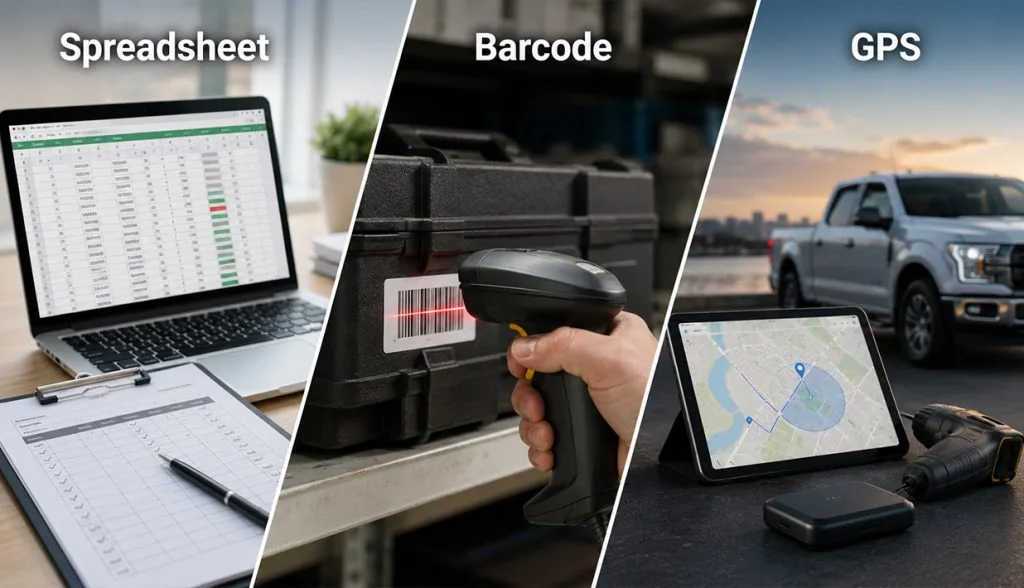
Equipment moving between job sites needs more than a list: each transition — arrival, inspection, custody — has to be a verified scan, because a spreadsheet cannot enforce a process and a barcode cannot be aimed through a construction day. Five stages make the audit trail.
01 / FIELD NOTE
Keep the decision tied to the operating context.
Construction equipment rarely stays in one place. Tools, generators, testing devices and specialty gear move between projects, and the movement — not the inventory — is where the management problem lives. When a crew arrives at a site, no one records what came; when a tool is needed, nobody knows whether it is already there; when equipment leaves, there is no record of who took it. A list that names the assets answers none of this, because the failures are about proof at handover, not about the count.
Three things break down when equipment crosses a site boundary. There is no proof of arrival — the receiving crew assumes the equipment is on site. There is no pre-use verification — a tool is used without the inspection that would catch a missing guard or a failed test. And there is no record of custody — nobody can confirm who accepted the equipment or who used it. Spreadsheets and clipboards name the assets; they cannot enforce any of these steps, because a spreadsheet is a place to write, not a gate to pass.
The correct mental model is lifecycle verification rather than location logging. The question is not "where is the equipment" but a chain of events: did it arrive at this job site, was it inspected before use, who received it, when did it go into service, when did it leave for the next site — and is there a record of every step. Each of those questions is answerable only by an event, and each event is answerable only at the moment it happens.
The five stages make the chain explicit. Tagging and registration assigns each asset a unique digital identity at the warehouse, establishing ownership and a home record. Dispatch assigns the equipment to a project with a timestamp and destination. Arrival confirmation is the mandatory scan on receipt that creates proof of arrival. Pre-use inspection requires a scan that logs condition before the equipment enters service. Transfer and check-out records the custody handoff as the item moves to the next site or returns to the yard. Skip any one of the five and the visibility across sites breaks — the chain is only as strong as its weakest handover.
The mechanism that fits a construction environment is the scan-as-gate: a read is not a courtesy log but a required step, and the tag is readable through the conditions that defeat a barcode. An RFID or NFC tag on the equipment reads without line of sight, survives dust, water and rough handling, and interacts through a phone that a worker already carries — even in gloves. Because each scan is a defined step, the system can refuse to move forward until the step it depends on is done: equipment cannot be marked in use without an arrival confirmation, and an inspection scan can be required before activation.
The division of labour between the technologies is consistent with the question each answers. GPS answers "where is it on the map" for machinery that moves over long distances and is worth the radio and battery; barcodes need the aiming discipline a busy site does not supply; RFID answers "was it here, when, and who handled it" for the hand tools and portable equipment that make up the bulk of the fleet. An operator holding a mix of machines and tools runs both: the map for the fleet, the scan chain for the floor.
The honest limit of the mechanism: the proof is only as good as the gate being enforced. A transfer recorded as a scan says custody changed hands; it does not say the tool was in good condition when it did, unless the inspection stage was run. And between the stations, the tag is silent — the system knows the last verified handover, not the item’s position under a bench since. The value is accountability at the moments a site can actually control: arrival, inspection, custody. The five stages make those moments real, and the scan-as-gate makes them happen.
02 / FIVE STAGES
A handover chain, not a count.
- Tagging and registration: a unique identity at the warehouse
- Dispatch: assigned to a project with timestamp and destination
- Arrival confirmation: a mandatory receipt scan
- Pre-use inspection: condition logged before service
- Transfer and check-out: custody recorded at the handoff
03 / THE SCAN-AS-GATE
A read that is required, not a courtesy.
- Equipment cannot be in use without arrival confirmation
- Inspection can be required before activation
- Transfers automatically create custody records
- The tag reads through dust, water and gloves
04 / THE DIVISION
Map vs scan chain.
- GPS for machines that move miles and need finding
- RFID for the hand tools and portable fleet
- Barcode needs the aiming a live site does not supply
- Between stations the tag is silent — the handover is the evidence
Bring the item, material, movement, target read and system context to a sample or project review.
Request a sample test