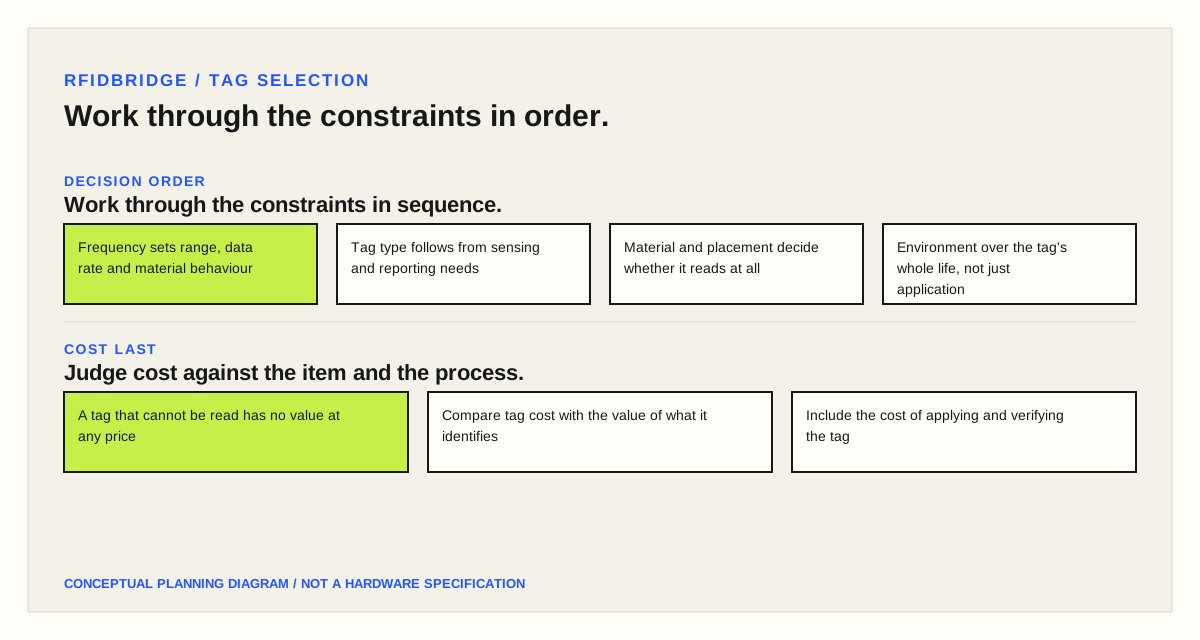
Frequency, tag type, material, orientation, placement and environment decide whether a tag works. Cost comes after those, because a cheap tag that cannot be read is not cheap.
01 / FIELD NOTE
Keep the decision tied to the operating context.
Choosing a tag means understanding both how tags and readers behave and what the business process does to the tagged object. The factors interact, so working through them in a fixed order prevents the common mistake of choosing on cost or size first and discovering the material problem afterwards.
Frequency comes first because it sets read range, data rate and how the tag behaves near water and metal. Where the process needs a deliberately short read — access control, payment — LF or HF is the fit, because a read that extends beyond a few centimetres is a security failure rather than a bonus. Where a pallet has to be read as it passes a dock door, the range has to come from UHF. Data rate follows the same split: LF is the slowest, HF is faster, UHF faster again.
Tag type comes next, and it follows from whether the tag needs to sense or report on its own. Passive tags are the cheapest and the longest-lived, and they are the default for case and pallet labelling. Semi-passive tags cost more but allow continuous sensing on a battery. Active tags cost more again and add their own transmissions. Cost has to be judged against the value of the item: a tag costing more than the thing it identifies is hard to justify, while a container worth a significant sum carries a different calculation.
Material is where selections most often fail. A tag attached directly to metal is detuned and reads poorly at any frequency. At UHF and microwave, a small controlled air gap between tag and metal can restore a usable read; LF and HF tags need a substantially larger gap. Water-bearing contents absorb UHF and microwave energy, so a tag on a liquid-filled bottle, a shampoo container or most food items has to be placed so the liquid is not directly behind the inlay. Neither problem is a reason to change frequency on its own — it is a reason to change the tag construction or where it sits on the object.
The environment the tag will pass through over its whole life is the next consideration, not just the environment where it is applied. A tag embedded in a product during manufacture may meet heat and pressure that a label applied at the end of the line never sees. A tag on a returnable container has to survive washing, handling and weather. Estimate the conditions across the full journey, because a tag that survives application but fails in transit produces exactly the silent absence a reader cannot distinguish from a missing item.
Orientation relative to the reader antenna changes how much energy the tag collects. Read range is greatest when the tag plane and the antenna plane are parallel, and falls as the tag rotates out of alignment, because the tag presents a smaller effective area to the incoming wave. Where orientation can be controlled — a conveyor, a fixed scan point — a linearly polarized antenna and a consistent tag placement give the most reliable read. Where items arrive in arbitrary orientations, a circularly polarized antenna trades range for tolerance.
Position within the zone matters as much as orientation. Power falls with distance from the antenna, and reflections from the surroundings mix with the direct signal, so the outer parts of a zone can contain pockets where the field is too weak to power a tag reliably. That is why a zone is measured rather than calculated, and why a tag that reads at the centre of a zone may be intermittent at the edge.
Standards and mandates constrain the remaining choices. Following an open standard such as Gen2 gives a wider choice of suppliers, usually at lower cost and with support available for longer, than a proprietary scheme. Where a trading partner mandates tags, the mandate may specify tag type, frequency, memory capacity, read rate and protocol, leaving only the manufacturer to choose. In that case the selection work is confirming compliance rather than comparing options.
02 / DECISION ORDER
Work through the constraints in sequence.
- Frequency sets range, data rate and material behaviour
- Tag type follows from sensing and reporting needs
- Material and placement decide whether it reads at all
- Environment over the tag's whole life, not just application
03 / COST LAST
Judge cost against the item and the process.
- A tag that cannot be read has no value at any price
- Compare tag cost with the value of what it identifies
- Include the cost of applying and verifying the tag
Bring the item, material, movement, target read and system context to a sample or project review.
Request a sample test