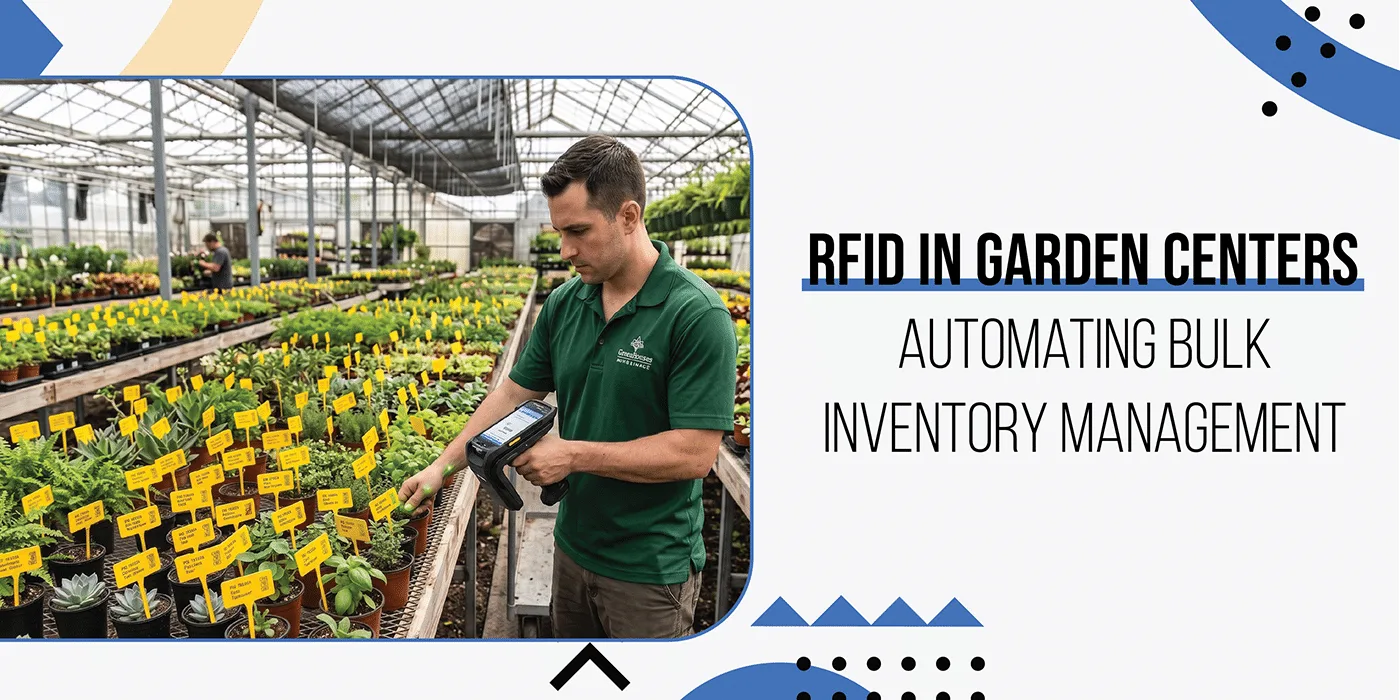
A garden centre holds plants that grow and die, bulk goods that are cheap per unit, and tools that go out on hire — three different inventory problems sharing one site.
01 / FIELD NOTE
Keep the decision tied to the operating context.
A garden centre is not one inventory. It is at least three, and they fail differently. Living stock grows, is watered, gets damaged and dies, so its count changes without anything being sold or moved. Bulk goods — compost, mulch, gravel — are cheap per unit and awkward per unit, so the counting effort is disproportionate to the value. And tool hire is a rental operation running inside a retail one, with assets that leave the site and are expected to come back.
The living stock is the case with no analogue elsewhere in retail. A plant that is unwatered is a loss the record never sees, because nothing moved and no transaction occurred. A plant that has grown out of its pot is still one unit until somebody re-pots it, at which point it may become two or become one of a different grade. Any identity scheme has to decide what the tagged unit is — the pot, the batch, or the display — and that decision is what makes the count mean something.
Tagging the pot rather than the plant is usually the practical answer, because the pot is what is handled, priced and sold, and it survives repotting in a way the plant does not. It also handles the case where the plant dies: the pot is emptied and reused, and the tag with it, which means the identifier has to be re-associated to whatever is planted next. That reassociation is a process step, and a process step that nobody owns is one that stops happening.
Outdoors is the durability case that most retail settings never face. A tag on a plant that stands in a nursery yard for a season sees ultraviolet light, rain, frost and repeated irrigation, and the adhesive that holds a label to a plastic pot is the part that fails first. Where the tag is attached matters as much as the tag: on the pot it may sit in standing water, on the plant it may be removed with a dead stem, and on a display sign it identifies the display rather than the stock.
Water is also the mechanism problem. Liquid absorbs the energy a passive tag needs to answer, so a densely irrigated block of pots is a harder read than the same block dry, and the difference between the two is the difference between a count that works and one that does not. This is measured rather than assumed, and it is measured on the real stock in the real yard rather than on empty pots indoors.
Bulk goods invert the usual economics. A bag of compost costs less than a well-made tag, so tagging each bag is a way of spending more on the record than the record is worth. The useful level is the pallet or the stack: tag the unit that moves, count the units on it once, and treat the display as the inventory position. That gives a count that is coarse and reliable rather than precise and unaffordable, and coarse and reliable is the right trade for goods of this value.
Tool hire is a different problem wearing the same uniform. A hired tool is a durable asset with a known value that leaves the site and returns, and each transaction is the moment its presence and its condition are decided. The commitment is made at the counter while the hirer is still standing there, which is exactly the moment when a bulk read at the counter can confirm what is going out and coming back without the transaction being slowed by an item-by-item check.
The maintenance state is the part that hire adds and retail does not have. A tool that comes back blunt, damaged or missing a part cannot go straight back onto the shelf, so the return has to capture a condition as well as a presence. That is a workflow fact rather than a technology one: the read confirms the tool is back, and something else has to record that it is fit to go out again — and where that second step is skipped, the count stays right while the hireable stock quietly shrinks.
Seasonality shapes the counting rhythm more than any other factor here. Stock can multiply in the weeks before a planting season and empty out afterwards, so a counting schedule that is uniform across the year spends its effort when there is least to find. Counting the categories that turn over quickest at the frequency their turnover justifies, and the slow structural lines rarely, is the same principle that applies to any warehouse and matters more here than most.
Where a site holds all three of these, the temptation is one scheme for everything. What such a scheme tends to produce is a tag on every item, a count of everything, and a record that is too expensive to keep current — at which point the counting reverts to seasonal and the infrastructure sits unused. The alternative is three levels deliberately chosen: item-level where the unit has value and leaves the site, pallet-level for bulk, and tag-free or batch-level for the low-value lines where the count is not worth the tag.
The honest limit is that this is a harder environment than a warehouse, and a plan that ignores that will produce a pilot that reads poorly and a conclusion that the technology does not work. Read it as a statement about the site rather than the tags: outdoor conditions, water, mixed unit values and a seasonal rhythm are all constraints that a covered, dry, uniform retail space does not have. Specifying against them is what makes the difference between a trial that survives a season and one that does not.
02 / THREE INVENTORIES IN ONE SITE
They fail differently, so they are counted differently.
- Living stock: the count changes without a sale or a movement
- Bulk goods: the unit is worth less than the tag
- Tool hire: the asset leaves and is expected to return
- One item-level scheme for all three is what makes it unaffordable
03 / WHAT THE GARDEN CENTRE ADDS
Constraints a covered retail space does not have.
- Ultraviolet, frost and irrigation acting on adhesive and print
- Water absorbing the energy a passive tag needs to answer
- Stock that changes grade or quantity while nobody acts
- A hire counter that is also a retail checkout
04 / CHOOSING THE LEVEL
Match the tag to what the unit is worth.
- Item level where the unit has value and leaves the site
- Pallet or display level for bulk goods
- Batch or tag-free for low-value lines
- Decide what the tagged unit becomes when a plant is re-potted
Bring the item, material, movement, target read and system context to a sample or project review.
Request a sample test