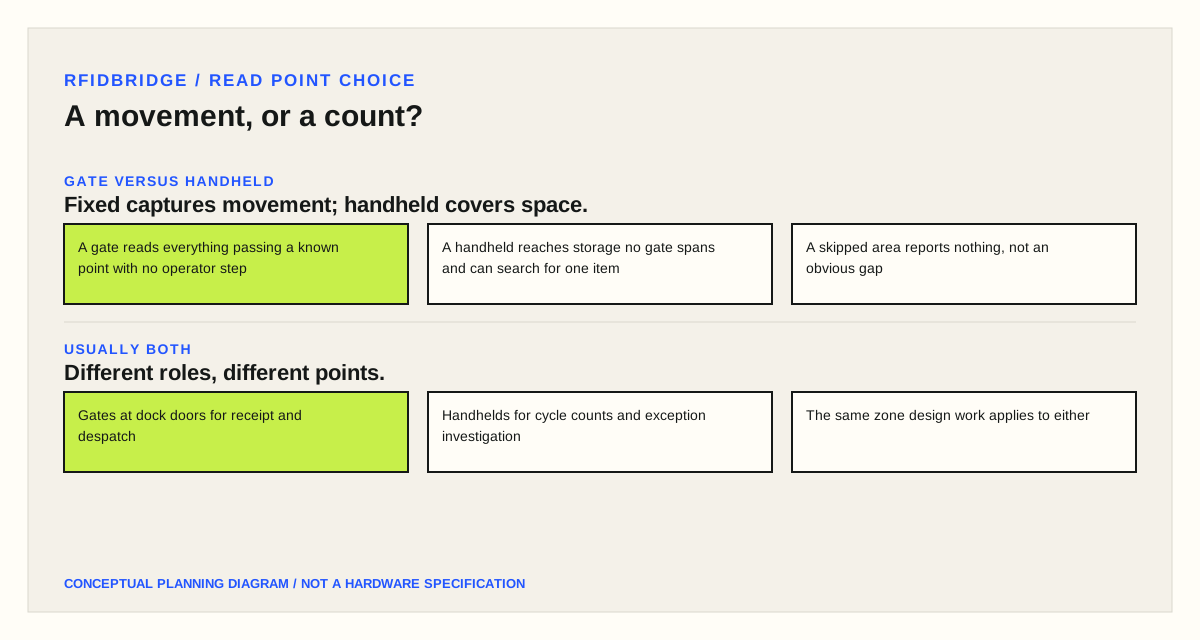
A gate reader reads what passes a fixed point; a handheld reads what an operator walks past. The choice follows from whether the inventory event is a movement or a count.
01 / FIELD NOTE
Keep the decision tied to the operating context.
The choice between a fixed gate reader and a handheld reader is usually presented as a hardware comparison. It is more usefully framed as a question about the event: is the inventory change caused by something moving past a point, or by someone counting what is there?
A gate reader is mounted at a fixed place — a dock door, a conveyor transition, a controlled doorway — and reads tags as they pass through its field. It requires no operator action, which means it captures movement at the moment it happens, including movements nobody thought to record. Its value is that it removes the decision to scan, and with it the possibility of forgetting.
Its limits follow from the same fixedness. A gate reads what passes through it and nothing else, so an item moved by a route that does not go through the gate is invisible. It reads everything in its field, including tags that were not the target, which makes zone design the critical work — the field has to include what should be read and exclude what should not. And because it observes continuously, the middleware has to decide what constitutes an event: a pallet pausing in the field for two minutes is one movement, not several.
A handheld reader is carried to the work. It reads what the operator points it at, which means it can cover storage locations that no gate spans — high racks, mixed pallets, a specific bay, a shelf that has not been counted in months. It is also the only practical way to search for a specific item once it is somewhere it should not be, because the operator can walk the area and read without having to see the tag.
The trade is between coverage and control. A gate reads every passing item at a known point but only at that point. A handheld can read anywhere but only where an operator goes, and it introduces a human step — the operator has to go, and has to read rather than assume. A count performed with a handheld is only as complete as the walk, and an area that was skipped reports no exceptions rather than an obvious gap.
In most warehouses the answer is both, in different roles. Gates at the dock doors capture receipts and despatches at the points where goods actually cross a boundary, which is where automatic capture is worth most. Handhelds handle cycle counting, exception investigation and finding items, which are tasks defined by their unpredictability. Trying to cover a whole warehouse with gates is usually disproportionate; trying to run receiving on handhelds alone makes the process depend on somebody remembering.
Whichever is chosen, the zone design work is the same. The read field has to be measured with the real items and their real tags, power and antenna configuration have to be set so the field covers what it should, and the behaviour at the boundary has to be checked — an item near the edge of a gate produces intermittent reads, which is worse than a clear failure because it looks like a passing item that was never there.
02 / GATE VERSUS HANDHELD
Fixed captures movement; handheld covers space.
- A gate reads everything passing a known point with no operator step
- A handheld reaches storage no gate spans and can search for one item
- A skipped area reports nothing, not an obvious gap
03 / USUALLY BOTH
Different roles, different points.
- Gates at dock doors for receipt and despatch
- Handhelds for cycle counts and exception investigation
- The same zone design work applies to either
Bring the item, material, movement, target read and system context to a sample or project review.
Request a sample test