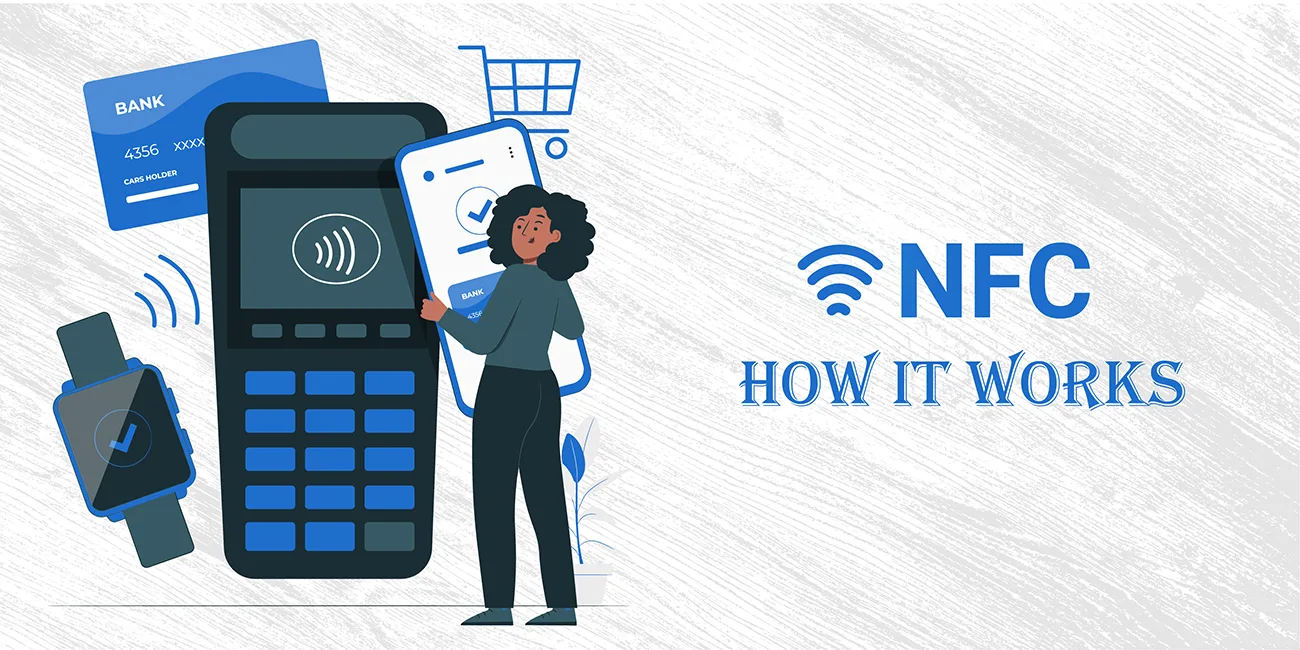
NFC is 13.56 MHz radio over a few centimetres: one device powers the other by induction, and the roles switch freely because a target is often a phone with its own power. Three modes — card emulation, reader, peer-to-peer — follow from that role change.
01 / FIELD NOTE
Keep the decision tied to the operating context.
NFC is a set of short-range radio techniques that work over a distance of a couple of centimetres, and the physics that makes them possible is inductive coupling at 13.56 MHz. The initiating device generates a magnetic field with its antenna; a target inside that field harvests enough energy to power itself and to answer. That one sentence contains the whole design: the target can have no battery of its own, because the field is the battery, which is why a tag can be a sticker, a card or a fob. The operating envelope is set by the frequency and the coupling — the data rate runs from 106 kbit/s to 424 kbit/s on the ISO 18000-3 air interface.
The asymmetry that makes NFC distinctive is that the target is often not a bare tag at all. A smartphone is a more complex device with its own battery, so the initiator and the target can switch places: the phone that was reading a sticker can itself become the thing being read. The technology is unusual in allowing that role change, and the three operating modes are exactly the three positions on that switch.
In card-emulation mode, the NFC device behaves as a passive smart card — the same role a contactless card plays. Because the mode does not require the processor or the operating system, an NFC phone in card-emulation mode keeps working even when the phone would otherwise be off; the radio answer comes from the card circuitry, powered by the reader’s field. This is the mode that lets contactless payments, ticketing and access control reuse the infrastructure already built for cards — the same readers, the same protocols, the same processes.
In reader-writer mode, the device is the active party: it reads, queries and writes tags in its field. A tag carries data — an address, a message, a small record — and the phone’s reader pulls it. The mode is the functional equivalent of a 2-D barcode scan, with the tag in place of the printed code, which is why it shows up in advertising, tickets and retail as the tap in place of the scan. Nothing in the interaction requires a central server; the data on the tag is the payload.
In peer-to-peer mode, two capable devices exchange data as equals. The canonical use is initiation: two phones tap, and the peer-to-peer exchange sets up a Bluetooth connection, after which the heavy traffic moves over Bluetooth. The same mode carries small content directly. The distinction from the other modes is that both sides are powered and both can initiate; the tap is a handshake that hands the session to a faster carrier.
The three modes map onto one physical layer because the radio protocol underneath is shared. The modes are specified in ISO/IEC 18092, the NFCIP-1 standard, with the card side drawing on ISO/IEC 14443, the contactless-smart-card standard; the same antenna and coupling serve all three, and the change is in the logical role. The design consequence is that one device, one antenna, one protocol stack covers payments, reading and pairing — the architecture does not grow per application, the mode selection does.
The honest limit of the physics is the envelope it draws: centimetre range, milliwatts of harvested power, kilobit data rates. Inductive coupling trades range for reliability — the field is strong close to the antenna and collapses within a short distance, which is exactly the property that keeps NFC interactions deliberate and short-range. The answer to "what can NFC do" is therefore bounded by the coupling: whatever fits in a near-distance interaction between two coils, powered by one of them, at 13.56 MHz, done in the time of a tap. The modes describe the ways that interaction can be aimed.
02 / THE PHYSICS
One field powers both halves.
- Inductive coupling at 13.56 MHz on ISO 18000-3
- The target harvests field energy — no battery needed
- 106 to 424 kbit/s within a couple of centimetres
- A phone with its own power can switch roles
03 / THE THREE MODES
Three positions on one role switch.
- Card emulation: the device acts as a passive card, even off
- Reader-writer: the device reads and writes tags
- Peer-to-peer: two devices exchange and hand off to Bluetooth
- One physical layer serves all three modes
04 / THE ENVELOPE
The coupling draws the boundary.
- Centimetre range makes taps deliberate
- Milliwatts of harvested power keep tags simple
- ISO 18092 and 14443 beneath the stack
- Cards, reading and pairing share one protocol architecture
Bring the item, material, movement, target read and system context to a sample or project review.
Request a sample test