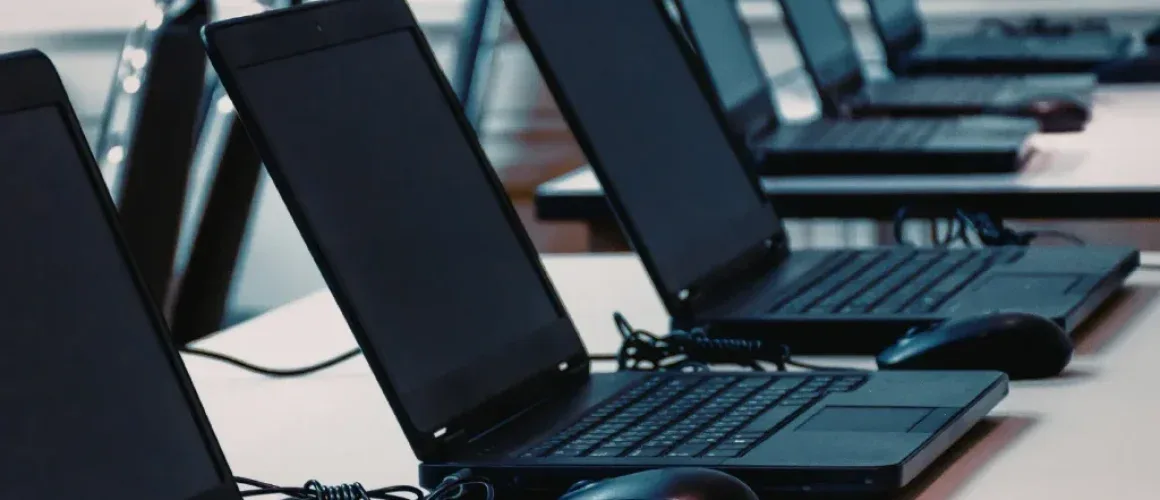
Metal mirrors the radio field and moves a label’s resonance off the reader’s transmit band, and a laptop lid or a server chassis is where that shows up first. What detuning does to a read, which tag construction answers it, and how a pilot is run on real hardware before any scale-up.
01 / FIELD NOTE
Keep the decision tied to the operating context.
An IT asset list is trusted only to the extent that the physical device still matches the record, and the record decays most quickly where the device is hard to reach or hard to scan. A laptop leaves through an office door, a server sits buried in a rack between two metal neighbours, a projector is borrowed for a project and lands in a different room. Every one of those movements is a place where the paper trail and the reality separate, and by the time the gap is noticed the record has already been used for a decision. The question worth asking first is not whether assets can be tagged at all, but why the same label behaves differently on a cardboard carton and on a metal chassis.
Barcode scanning works until the label is out of reach or the line of sight is gone, and both fail on IT equipment as a matter of routine. A label on the back of a rack-mounted unit is behind the unit and the cable bundle; a label inside a battery bay was decided at design time, not at deployment time. The radio approach reverses the geometry: the tag no longer needs to be visible or aligned, only to be inside the reader’s field at the moment of the scan. That changes the audit from a per-item hunt into a sweep of the room, but it moves the risk to a different place — the tag and its host now have to cooperate with the physics of the interrogation rather than with the eye.
The detuning problem is a property of the antenna, not of the inlay. A dipole stores its resonance at a design length, and that length assumes the air around it is uniform. Metal beneath or beside the tag acts like a mirror: it creates an image of the antenna close by, splits the field, and moves the resonance away from the reader’s transmit band. The symptom is a tag that reads comfortably on the bench and refuses to appear once attached, which is why a datasheet read range is the start of a test rather than a planning number. The on-metal answer is a second design that uses the metal instead of fighting it — a patch element with a controlled ground plane below.
An on-metal construction earns the name by supplying a ground plane of its own. Its antenna is typically a patch whose back face sits at a fixed offset from the asset’s metal, with a dielectric layer in between, so the spacing becomes repeatable no matter which device the tag is stuck to. That repeatability is the real point: a laptop lid, a switch housing and a rack rail all present the same electrical surface after attachment, and the tag’s tuning stops depending on the particular host. Flexible labels for thin covers and rigid tags for thick chassis are the two ends of the same idea, differing mostly in how much separation the construction can afford.
A laptop is the instructive case because its surface is metal on some models and composite on others, and both can detune a label. The lid and the base are packed with planes — battery, shielding, display backplate — so the working habit is to assume the worst and test the chosen label on the actual models in service. The audit consequence matters more than the placement debate: a tag on the lid reads from a closed stack in the storage room, while a tag down in the battery bay demands the unit be opened to be seen. Where a fleet mixes models, the position has to survive every model in the fleet, a decision taken from the hardware list rather than from the datasheet.
A server is the opposite geometry: it rarely moves and it is hard to reach once installed. The tag sits between steel neighbours in a rack, inside a tangle of cables, behind doors, occasionally under the chassis cover itself. The interference is not one source but a pattern — the rack uprights, the units above and below, the door left ajar in the aisle — and the pattern differs at every position in the rack. The read point therefore deserves as much attention as the tag: the question is where the reader can stand so the field reaches the whole rack, and that is answered by walking the room with the reader in hand before committing the installation.
A read only has value when the software decides what it is allowed to mean. A reader mounted at a storage-room door and a reader carried through the room produce different observations — one a boundary crossing, the other a presence confirmation — and they have to be treated differently. A crossing can feed checkout or return only when direction is known or the action is completed at a counter; a sweep confirms that a device was in the room at the time of the sweep, which is exactly the evidence an inventory wants. Deciding the event types before configuring the system is what keeps the log useful instead of noisy. The identity on the tag stays minimal — a serial that points at the record.
The pilot is a deliberately small loop run before the system scales. Choose one asset category, keep its list clean, and carry two or three candidate tags through the real placement on the real devices; run the reader the way the daily workflow will run it, sweep the room, and compare the result with the list. A missed device at this stage points at placement or read position, and fixing it before rollout is cheap in a way that fixing it after trust is already built is not. The site survey belongs in the same step, because reader position and interference are the variables a bench test never sees.
Two operations decide whether the system earns its keep. The first is return: a device comes back from an assignment, and the system has to tell a genuine return from a device merely passing the door on its way to another room. The second is the inventory itself, whose output is a variance list — what the sweep found, what the record expected, what is missing — and each missing entry is the start of a search rather than a question. Overdue returns and devices that never reappear are the workflows that turn the log into action, and they work only if the tag was bound to the right record at the start.
Two limits belong on the record. The first is that nothing in a passive read reports where a device is in real time: the read points give zones and moments, and a device in a desk drawer between sweeps is accounted for at the next sweep, not before it. The second is that the ledger inherits every error the binding step made — a tag linked to the wrong record reproduces that mistake at every later read. The system provides a faster and more repeatable way to compare the physical room with the digital one; it does not supply the discipline that keeps the record true between comparisons.
02 / WHY METAL BREAKS A LABEL
Metal mirrors the field and moves the resonance; the catalogue range is not the installed range.
- A dipole tunes to air, and metal beside it moves the resonance off the transmit band
- The symptom: reads on the bench, silent once attached
- An on-metal patch carries its own ground plane, so the host stops tuning the tag
- The same construction reads consistently on a lid, a chassis and a rack rail
03 / TWO ASSET GEOMETRIES
Laptops move and servers hide, and each shape decides where a read can happen.
- Laptop: closed lids in a storage room are the real read geometry
- Server: rack steel, neighbours and cable runs make every slot its own case
- Position is decided from the fleet’s models, not from the datasheet
- A door crossing and a room sweep are different events, configured differently
04 / THE PILOT LOOP
One category, a clean list, real devices, then a comparison.
- Choose one asset category and keep its list clean
- Carry candidate tags through the real placement on the real devices
- Sweep the room as the daily workflow will, and match the results to the list
- Fix placement and reader position before rollout, not after trust is built
Bring the item, material, movement, target read and system context to a sample or project review.
Request a sample test