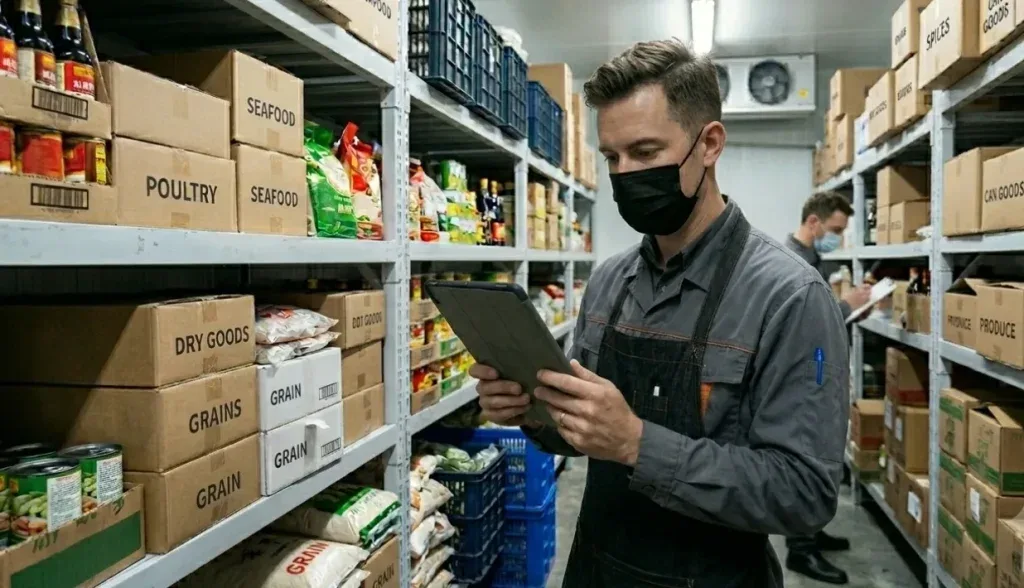
Kitchens combine metal, liquid, cold storage and heat, which is the least forgiving set of conditions for passive UHF. The useful question is which items repay tagging and which need a different method.
01 / FIELD NOTE
Keep the decision tied to the operating context.
A restaurant holds two kinds of inventory that behave nothing alike. There is food — ingredients, prepared components, beverage — which is consumed continuously and has a shelf life measured in days. And there are operating assets — containers, trays, small equipment, delivery crates — which are not consumed at all but migrate. A tracking approach that suits one usually suits the other poorly.
Food inventory has the harder problem: it moves constantly during service, it is stored in conditions hostile to radio, and the person moving it is busy. Any process that asks a cook to scan during a dinner service will be abandoned within a week, regardless of how good the data would have been.
The physical conditions are the constraint. Passive UHF relies on radio energy reaching a tag and the tag’s reply reaching the reader. Water absorbs energy in the UHF band, and most food is largely water, so a tag on a liquid container or buried in a full chest freezer reads poorly or not at all. Metal reflects, so a tag against a stainless steel prep table, a shelving unit or a keg has its behaviour changed by whatever it is touching. Neither condition is a reason to abandon the idea; both are reasons to select the tag and the reading position for the item rather than for the technique.
Cold storage adds a second effect. A tag in a freezer is being asked to operate in a cold, often frost-covered environment, and ice and condensation between the tag and the reader attenuate the signal. A tag that reads perfectly on a dry shelf can be unreliable behind a closed freezer door, which means a freezer count is usually a task done with the door open and the handheld close, not a portal read from the aisle.
Heat is the third constraint, and it is about survival rather than signal. A tag that goes through an oven, a dishwasher or a microwave is being asked to endure conditions its construction may not tolerate, and a tag that fails silently is worse than no tag, because the system will keep reporting the last identity it heard. Any reusable container that passes through heat needs a tag specified for that exposure, and needs the failure mode understood: does a damaged tag stop responding, or respond with corrupted data?
Given all of this, the productive approach is to choose the level of the problem before choosing the technology. Counting individual steaks is a different problem from knowing how many cases of a staple are in dry storage and different again from knowing how many reusable delivery crates came back. Each has a different tolerance for error and a different cost per unit of accuracy.
Where tagging pays off most reliably in a kitchen is on containers rather than contents. A sealed ingredient bin, a beverage keg, a reusable crate, a thermal delivery box: these cross defined points — the walk-in door, the loading bay, the return dock — and they are handled as whole units. A tag on the container answers a real question at each crossing without asking anyone to scan during service.
High-value and high-turnover consumables are the next tier, and here the mechanism that helps is not continuous tracking but count frequency. A stock area that can be counted in a couple of minutes with a handheld, while standing at the shelf, will actually be counted — weekly, then daily — and frequent counting corrects drift that continuous tracking would have to be perfectly reliable to prevent. The value comes from the ease of the count, not from the elegance of the system.
Beverage operations sit in between and deserve their own look, because the containers are often metal and often cold. A keg is a metal cylinder full of liquid: two of the three hostile conditions at once. Where kegs need tracking, the tag has to be chosen for a surface-mounted or spacer application and the reading point has to be a place where the keg is stationary and accessible rather than a gate it rolls through.
Asset tracking is the quieter, often better return. Trays, smallwares, mobile carts, thermal carriers and delivery crates leave the premises and come back on someone else’s schedule. Their losses are individually small and collectively significant, and the questions asked of them — is it here, did it come back, how many are out — are exactly the questions a tag on a container answers well and cheaply.
Multi-site operations add a data problem on top of the physical one. If each site counts in its own way, at its own interval, into its own format, the consolidated picture is an average of incompatible estimates. Agreeing what a count means, what triggers one, and what the exception categories are matters more than which reader each site buys, and it is the part that is usually skipped.
The honest conclusion for most kitchens is a split approach. Tag the containers, crates and assets at the level where a whole-unit read is meaningful, count consumables frequently with a handheld rather than continuously with infrastructure, accept that a freezer count is a manual task with a handheld, and pick the tag for the surface it will touch. Trying to make one method cover the whole kitchen is what produces a system that reports confidently and is quietly wrong.
02 / KITCHEN CONSTRAINTS
Three conditions decide what will read.
- Water and liquid content absorb UHF energy
- Metal surfaces detune a tag placed against them
- Ice, condensation and closed doors attenuate the path
- Heat exposure is a survival limit, not a signal limit
03 / WHAT REPAYS TAGGING
Match the level to the question.
- Containers, kegs and crates that cross defined points
- Reusable assets that leave and must come back
- Consumables counted frequently rather than tracked continuously
- Freezer and liquid stock counted by handheld at the shelf
Bring the item, material, movement, target read and system context to a sample or project review.
Request a sample test