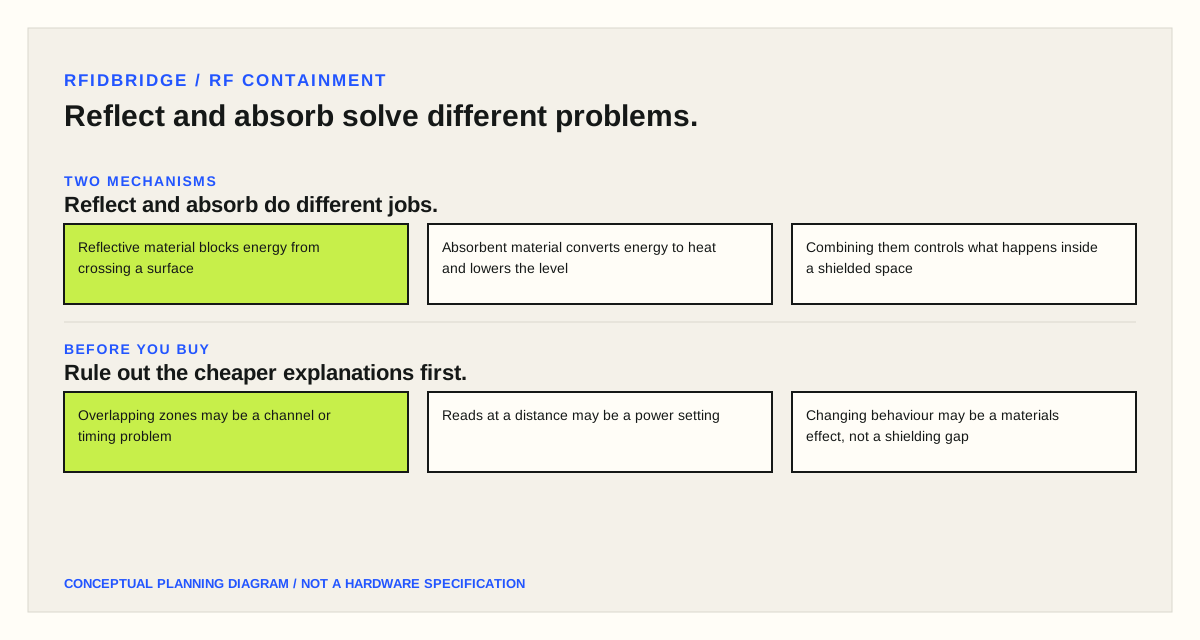
Shielding material, absorbent material and reader configuration solve different versions of the same problem — a read that escapes its zone or a signal that intrudes into it.
01 / FIELD NOTE
Keep the decision tied to the operating context.
Shielding is what you reach for when a read zone will not stay inside its intended boundary. The symptom is usually one of two things: tags outside the zone are being read, or a signal from somewhere else is degrading reads inside it. Both are radio-containment problems, and both have more than one possible fix.
Reflective shielding uses conductive material — metal foil or sheet, conductive fabric, or a metalized coating or paint — to stop radio energy passing through a surface. Absorbent material works differently: rather than reflecting energy away it converts it to heat, which lowers the signal level rather than redirecting it. The two are often combined, with an absorber reducing the energy that would otherwise bounce around inside a shielded space.
The choice between them follows from what you are trying to achieve. If two adjacent read points interfere with each other, a barrier between them may be the simplest answer. If a metal structure is reflecting energy back into a zone and creating reads in unexpected places, an absorber on that surface reduces the reflection instead of moving it elsewhere. Adding a reflector where the problem is a reflection can make it worse.
Several situations produce the same symptom and need different treatment. A checkout lane reading stock on a nearby shelf is a containment problem. Two dock doors whose zones overlap is a channel and timing problem, which reader configuration may solve before any material is installed. A reader whose own transmissions mask the tag replies it is trying to hear is a dense-reader problem. A zone that behaves differently when a delivery arrives is a materials problem. Diagnosing which one you have is worth more than choosing a material.
Where a physical barrier is the right answer, the material has to match the environment it lives in. Foil and sheet are straightforward to install on flat surfaces but are rigid and can be damaged by impact. Conductive fabrics are flexible and suit curved or irregular surfaces, and are common where hard panels are impractical. Metalized paints and coatings retrofit existing structures without rebuilding them, but their effectiveness depends on how evenly they are applied. Absorbers come as ferrite tiles, carbon-loaded foam and other composites, and their behaviour is frequency-dependent, so the material has to be selected for the band in use rather than for the word "absorber" on a datasheet.
When comparing absorbers, the parameters that matter are the frequency range and its bandwidth, the attenuation the material actually provides, and how it behaves under the temperature, humidity and chemical conditions of the installation. Insertion loss, reflection coefficient and power handling describe what the material does to a signal; thickness and flexibility describe whether it will fit. Ease of installation and expected service life decide whether it stays effective.
A barrier also has consequences beyond the radio behaviour. Metal in a warehouse aisle is something a forklift can hit. A lining on a dock wall is something that has to survive being loaded against. Material near a conveyor has to tolerate the product and the cleaning regime. Those are reasons a shielding decision belongs with the operating procedure, not only with the radio design.
Before ordering material, confirm what the problem actually is. Move a tag to the boundary of the zone and see where the read starts and stops. Take the power down and see whether the interference disappears. Move the antenna rather than the shelf. If a barrier still looks necessary, define the boundary you need, measure the zone with the barrier in place, and check that reads inside it did not get worse — a shield that stops a stray read but weakens the intended one has moved the problem rather than solved it.
02 / TWO MECHANISMS
Reflect and absorb do different jobs.
- Reflective material blocks energy from crossing a surface
- Absorbent material converts energy to heat and lowers the level
- Combining them controls what happens inside a shielded space
03 / BEFORE YOU BUY
Rule out the cheaper explanations first.
- Overlapping zones may be a channel or timing problem
- Reads at a distance may be a power setting
- Changing behaviour may be a materials effect, not a shielding gap
Bring the item, material, movement, target read and system context to a sample or project review.
Request a sample test