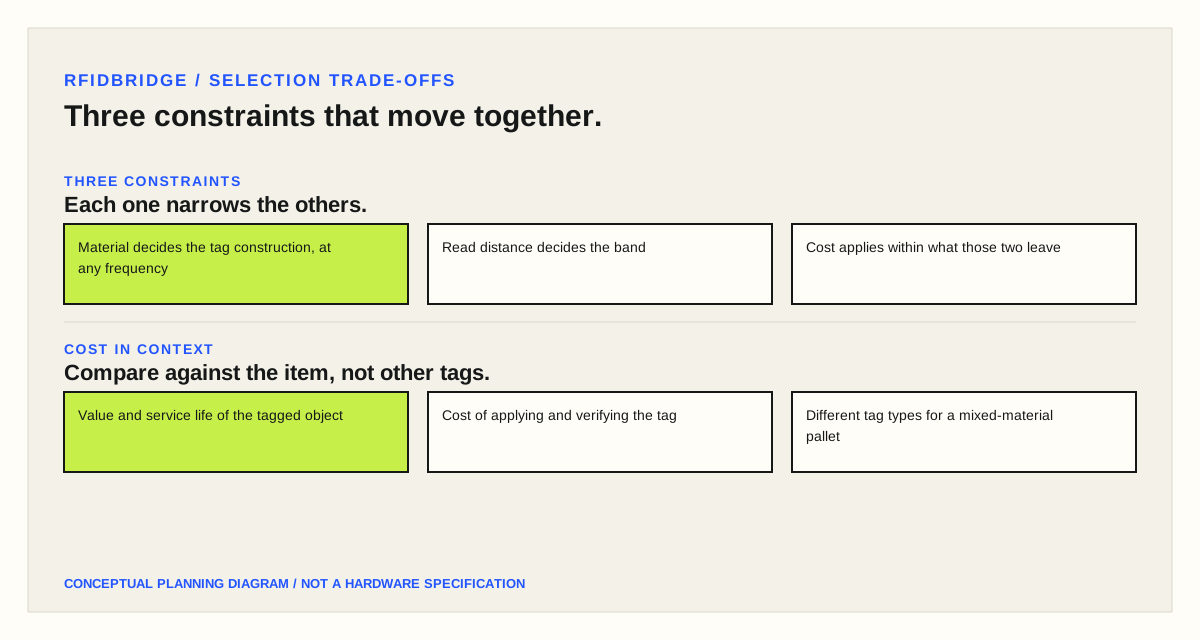
Cost, material and frequency constrain each other. Fixing any one of them first narrows the other two, which is faster than comparing tag catalogues.
01 / FIELD NOTE
Keep the decision tied to the operating context.
Tag selection is usually presented as a comparison of products. It is more usefully understood as three constraints that move together: what the item is made of, how far away it has to be read, and what the tag may cost. Fixing the first two narrows the third to a small range, and the choice becomes a shortlist rather than a catalogue.
Material is the hardest constraint and the one that most often gets decided last. A tag attached directly to metal is detuned and reads poorly, and no frequency avoids this — what changes is the remedy. At UHF and microwave frequencies, a small controlled air gap between the tag and the metal surface can restore a usable read. At LF and HF, the required gap is much larger, which in practice means a different tag construction rather than a spacing adjustment. Water-bearing contents absorb UHF and microwave energy, so a tag on a bottle, a liquid container or most food has to be positioned so the liquid is not directly behind the inlay.
Frequency follows from material and range together. A read that must not extend beyond a few centimetres — an access credential, a payment card — points at LF or HF, where short range is a security feature rather than a limitation. A pallet read as it passes a dock door needs the metres that UHF delivers through backscatter. Between those extremes sit applications where the range is negotiable and the decision falls to material behaviour and the availability of suitable inlays.
Cost then applies within what is left. The right comparison is not tag price against tag price but tag cost against the value and the lifetime of what it identifies. A returnable container that stays in service for years carries a different calculation from a carton that is discarded on receipt, and an item whose loss is expensive justifies a tag that a low-value consumable does not. The cost of applying and verifying the tag belongs in the same figure — a cheaper label that takes longer to place correctly is not cheaper in a high-volume operation.
Several effects are easy to overlook at this stage and expensive to discover later. An inlay optimised for one material may be poor on another, so a mixed pallet may need more than one tag type or a placement that works for both. A tag that performs in a test read on a bench may behave differently once applied to the object and surrounded by others. And a tag that is read reliably at the centre of a zone may be intermittent at its edge, where the field weakens and reflections from the surroundings mix with the direct signal.
The efficient order is therefore: establish the material and the read distance from the process, choose the frequency that satisfies both, then select a tag construction that survives the environment and fits the cost the item can carry. Where a mandate from a trading partner fixes the frequency and tag type, the remaining work is confirming that the specified tag actually reads on your material in your read zone — which is a test, not a datasheet comparison.
02 / THREE CONSTRAINTS
Each one narrows the others.
- Material decides the tag construction, at any frequency
- Read distance decides the band
- Cost applies within what those two leave
03 / COST IN CONTEXT
Compare against the item, not other tags.
- Value and service life of the tagged object
- Cost of applying and verifying the tag
- Different tag types for a mixed-material pallet
Bring the item, material, movement, target read and system context to a sample or project review.
Request a sample test