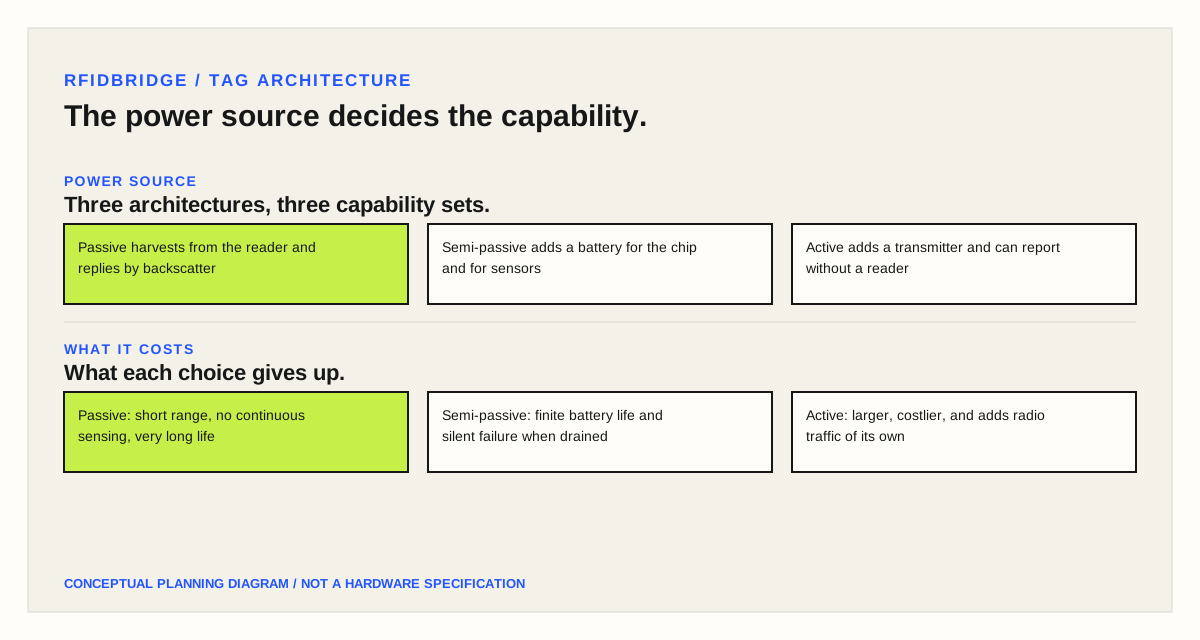
The power source decides a tag's read range, whether it can carry a sensor, how long it lasts and whether it adds radio noise — so it is the first selection question, not the last.
01 / FIELD NOTE
Keep the decision tied to the operating context.
A tag has to power its own chip to process what the reader sends and to send a reply back. Where that power comes from is the most consequential choice in tag selection, because it determines range, sensor capability, service life and whether the tag contributes to the radio noise floor.
A passive tag has no battery. It harvests what it needs from the reader's carrier, which is a very small amount of energy — enough to run the chip, not enough to run a transmitter. Instead of transmitting, it changes how it reflects the incoming wave, a technique called backscatter, and the reader detects that change. The absence of a transmitter is why passive tags add nothing to the noise floor, and why they can sit in a warehouse for years.
That economy has limits. Passive tags hold a modest amount of data, need a reader capable of delivering enough power at the required distance, and reach from a few centimetres to roughly six metres depending on frequency, antenna and environment. Whether short read range is a defect depends entirely on the job: on an access card or a payment card, a short range is the point, because a card that can be read from across a room is a security problem. On a pallet moving through a dock door on a forklift, short range is a real constraint.
At low and high frequencies a passive tag couples to the reader inductively, which suits small, close-range labels and cards. At UHF and microwave frequencies it couples through the radiated field, which is what makes metre-scale ranges possible. That difference in coupling is why frequency and power source are chosen together rather than separately.
A semi-passive tag — also called semi-active, battery-assisted passive or BAT — carries a battery that powers the chip, but still has no transmitter and still replies by backscatter. The battery buys two things. It extends read range because none of the harvested energy has to run the chip, and it makes an onboard sensor practical, since a sensor needs continuous, reliable power at a level a passive tag simply cannot supply.
The sensor case is the usual reason to accept a battery. Temperature, humidity, shock and similar measurements need power between reads, not only during the moment a tag is in the field. A passive tag is only powered while it is inside the interrogation zone, which is a small fraction of its life, so a sensor on a passive tag has nothing to run on when it matters.
The cost of a battery is a finite life and a failure mode that is hard to see. A reader cannot distinguish a tag whose battery is drained from a tag that is absent — both are simply silent. Cold conditions can stop a battery working even when it is not exhausted, so a tag on an outdoor asset in winter may go quiet for reasons that have nothing to do with the asset. Published shelf life is typically in the range of a few years, and frequent interrogation draws the battery down faster than shelf life suggests.
An active tag has both a battery and a transmitter. It does not need the reader's carrier to reply and does not strictly need a reader at all: it can broadcast its identity on a schedule, at a set time, or when an event occurs. That independence gives the longest range of the three by a wide margin, and it allows more processing and storage on the tag. It also means the tag contributes its own radio traffic, which is a factor in any site with many tags transmitting.
The reason not to put a transmitter on a semi-passive tag is economic and physical: a transmitter needs more electronics and a larger power source, which makes the tag bigger, heavier and more expensive. If data is only needed while the tag is in a read zone, that extra capability is paid for and never used.
In practice the choice follows from three questions. Does the tag need to report on its own, without a reader present? Does it need to measure something continuously? Is the item valuable enough to carry a battery that will need replacing or that will fail silently? A no to all three points at passive. A yes to the sensor question, with reads still happening at a defined point, points at semi-passive. A yes to independent reporting points at active — and usually at a different system design, because a network of self-reporting tags is a different architecture from a reader-driven one.
02 / POWER SOURCE
Three architectures, three capability sets.
- Passive harvests from the reader and replies by backscatter
- Semi-passive adds a battery for the chip and for sensors
- Active adds a transmitter and can report without a reader
03 / WHAT IT COSTS
What each choice gives up.
- Passive: short range, no continuous sensing, very long life
- Semi-passive: finite battery life and silent failure when drained
- Active: larger, costlier, and adds radio traffic of its own
Bring the item, material, movement, target read and system context to a sample or project review.
Request a sample test