An RF scanner reads tags by radio rather than by line of sight. The difference changes what a scan step can be, not just how fast it runs.
01 / FIELD NOTE
Keep the decision tied to the operating context.
An RF scanner is a reader that identifies items by radio instead of by a printed pattern. The immediate effect is speed, but the more important effect is that line of sight stops being a requirement — and that changes what a counting or checking step is able to do.
A barcode scanner needs the code in view, at the right angle, one at a time. An RF scanner radiates a field and reads every tag that answers within it, so a shelf, a cart or a pallet can be read as a group without unloading it. What was a sequence of individual scans becomes a single observation of a population.
That shift has consequences beyond speed. A scan step that reads a population can report what is absent as well as what is present, because the expected list is known and the observed list is compared against it. A step that reads one item at a time cannot do that without an additional reconciliation. This is why RFID changes counting, cycle counting and receiving workflows rather than merely accelerating them.
The equipment comes in forms suited to different work. A handheld reader suits exception handling, verification and reading that has to happen at a chosen moment in a chosen place. A fixed reader mounted at a doorway or conveyor reads as items pass, with no operator action. A vehicle-mounted reader reads while a forklift moves, which suits shipping and receiving at a dock. Each form implies a different workflow, and choosing the form is choosing the workflow.
What an RF scanner cannot do is equally worth knowing before committing. Reading a population means reading whatever is in the field, including tags that were not the target, so the zone has to be designed to include what should be read and exclude what should not. Radio is affected by the material around it, so a read that works on a bench may behave differently on a metal shelf or beside liquid. And because a read is an observation rather than a deliberate act, the system has to decide what a repeated observation means — the same tag seen five times is still one item.
The practical starting point is to describe the step you want to change in terms of what has to be known at the end of it. If the answer is a count of what is present, RFID is a strong fit. If the answer is confirmation that one specific item was handled, the design needs a way to distinguish that item from its neighbours. If the answer depends on conditions in the room — metal, liquid, other radio equipment — that is where the design work begins rather than ends.
02 / WHAT CHANGES
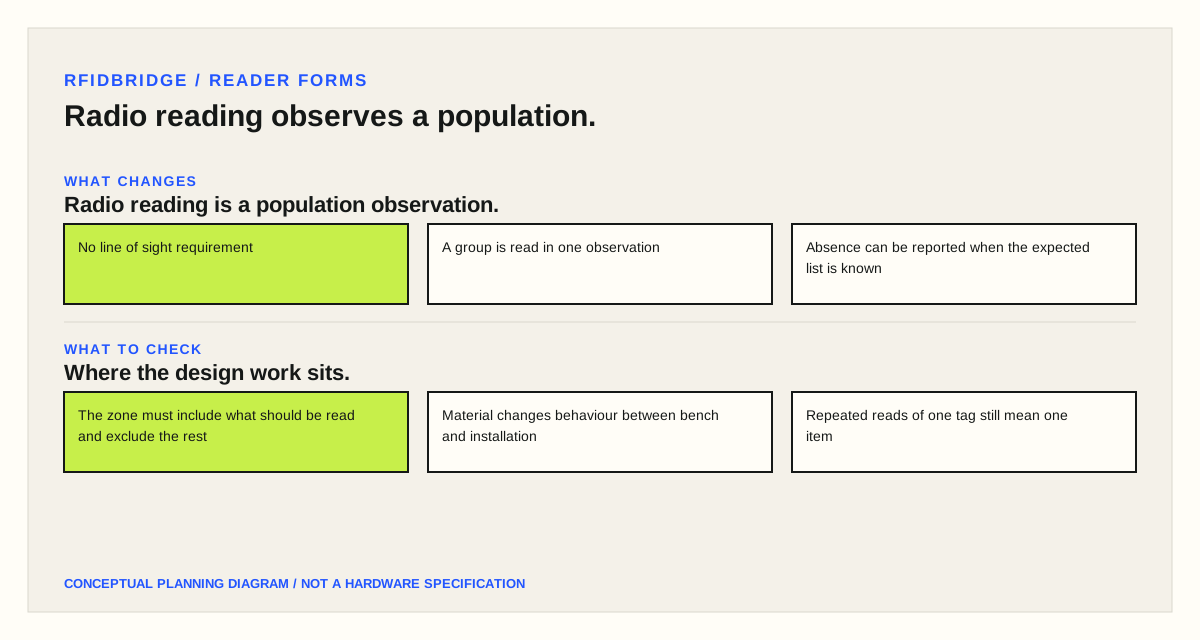
Radio reading is a population observation.
- No line of sight requirement
- A group is read in one observation
- Absence can be reported when the expected list is known
03 / WHAT TO CHECK
Where the design work sits.
- The zone must include what should be read and exclude the rest
- Material changes behaviour between bench and installation
- Repeated reads of one tag still mean one item
Bring the item, material, movement, target read and system context to a sample or project review.
Request a sample test