Food and beverage
Ingredient, packaging, inventory and movement workflows with application-specific tag and hygiene checks.
01 / THE QUESTION
Where does
visibility break?
Ingredient, packaging, inventory and movement workflows with application-specific tag and hygiene checks. RFID becomes valuable when it reduces a specific handoff, search, count or verification problem and puts a trusted event into the right system.
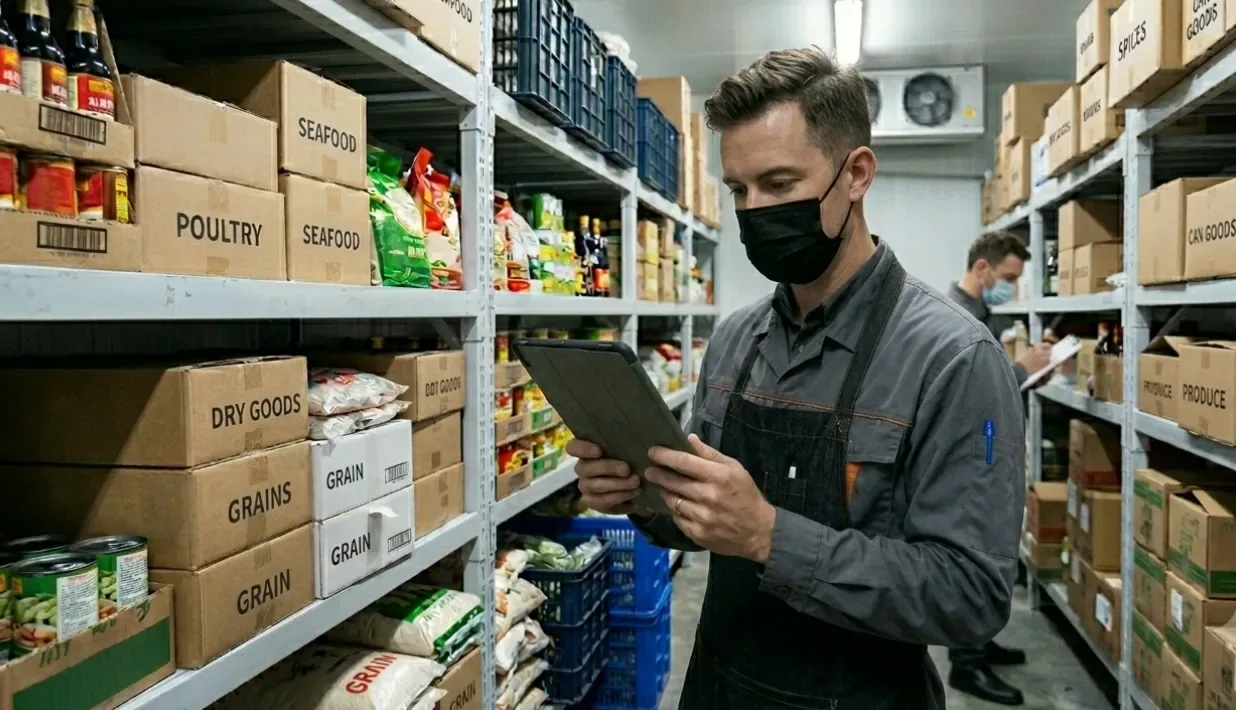
FIELD VIEW / INGREDIENT FLOW
Make movement
easy to verify.
Food and beverage RFID can connect ingredient, packaging and inventory handoffs when tag materials, hygiene conditions and read points are tested together.
- Identify ingredient, packaging or returnable units at handoffs
- Capture receiving, storage and issue events
- Test attachment, cleaning exposure and read behavior on representative items
02 / INDUSTRY WORKFLOW
Four moments.
One accountable handoff.
Turn receiving, put-away and cycle counts into faster, more observable warehouse workflows. The sequence below is specific to the operating environment and remains subject to representative testing.
Identify the receiving unit
Define whether the event concerns a case, pallet, ingredient, container or another measurable unit.
Check the material context
Test moisture, cold areas, packaging variation and placement with the actual receiving or storage routine.
Reconcile the receipt
Compare the observed identity and quantity with the expected record and make exceptions reviewable.
Release or return
Send the accepted receipt, hold or return state to the responsible inventory or logistics workflow.
03 / INDUSTRY KIT
Equipment follows
the operating point.
A starting configuration for this industry may include these elements. The exact model, tag construction, region and availability remain project questions.
04 / INDUSTRY-SPECIFIC SCOPE
Make the material
and risk explicit.
Industry context changes the test. These are the details to carry into the first sample, site survey or proof of concept.
Read the planning guideCases, reusable containers, ingredients, storage zones and receiving records.
Moisture, cold areas, packaging variation and a process event without a clear unit of measure.
Validate one receiving or reusable-container loop with material, temperature and exception conditions represented.
05 / SYSTEM HANDOFF
Respect the
system of record.
Food and beverage workflows should preserve unit, quantity context, location, time and hold or return status in the receiving record.
06 / DEPLOYMENT PATH
Prove one
repeatable moment.
Map read zones, configure power and session settings, pilot one process and publish an operator playbook before site-wide deployment.
- Define the acceptance target
- Test the item and environment
- Train the people who own the exception
- Scale only after the workflow is usable
07 / INDUSTRY FAQ
Scope the first
conversation.
Metal racks can create reflections and read zones that are too broad. Antenna direction, power, tag choice and pilot testing are all part of the design.
Yes. We document the site profile, configuration baseline, training checklist and acceptance test so a proven design can be replicated.