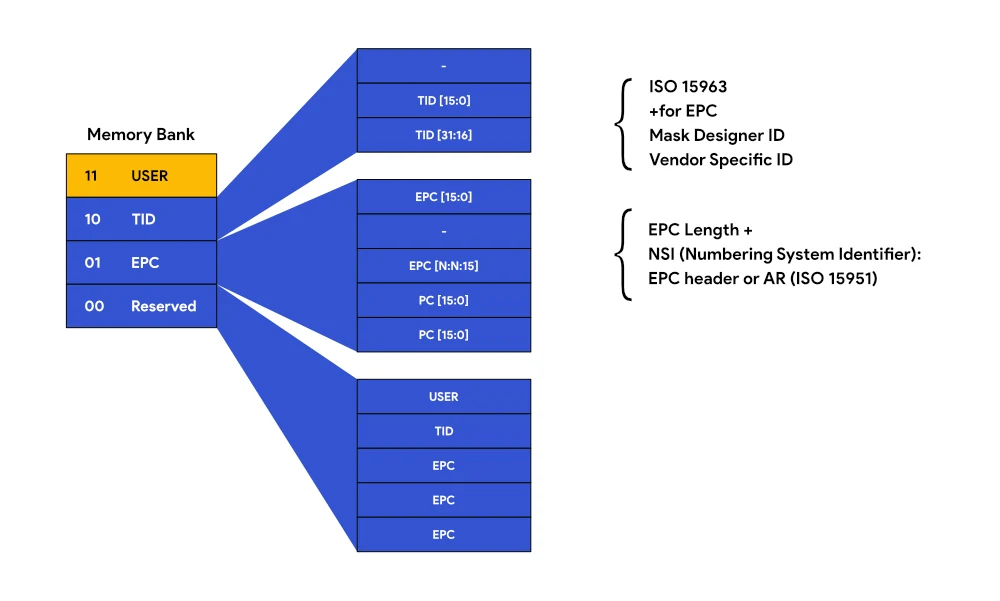
A tag memory map is part of the data contract between the tag, reader and business system. Treat the common Gen2 memory roles as a planning model, then confirm the actual chip, access rules and encoding workflow before deployment.
01 / FIELD NOTE
Separate identity from payload
Use the EPC area or equivalent identifier field for the identity that the workflow must recognize, and decide whether any application data belongs on the tag at all. Keep the system of record authoritative instead of copying every business field into tag memory.
02 / FIELD NOTE
Understand the memory roles
Common Gen2-style tags expose reserved controls, an EPC area, a tag-identification area and sometimes user memory. Their presence, size, locking behavior and write capability vary by chip and configuration, so the label alone is not a complete memory specification.
03 / FIELD NOTE
Define the data boundary
Decide which value identifies the tagged object, which fields remain in the business system and which tag data, if any, must be available offline. Minimize sensitive data and avoid treating tag memory as a replacement for the system of record.
04 / FIELD NOTE
Define access and lifecycle
Record who may read, write, lock or use password-protected operations, when the tag is encoded, and what happens when a tag is replaced or its data is unreadable. Keep credentials or access values under the project security process.
05 / FIELD NOTE
Align encoding and mapping
Document the value written, encoding rules, reader permissions, packaging level and downstream field mapping. Make the replacement process explicit so a new tag does not silently create a second identity or orphan the original record.
06 / FIELD NOTE
Verify the complete path
Test the selected tag and reader with the intended protocol, encoding rules and system mapping. Confirm the value that is written, the value that is read, the business event it creates and the recovery path for a failed or partially written operation.
Bring your material, movement, target read and system context to a sample or quote request.
샘플 요청