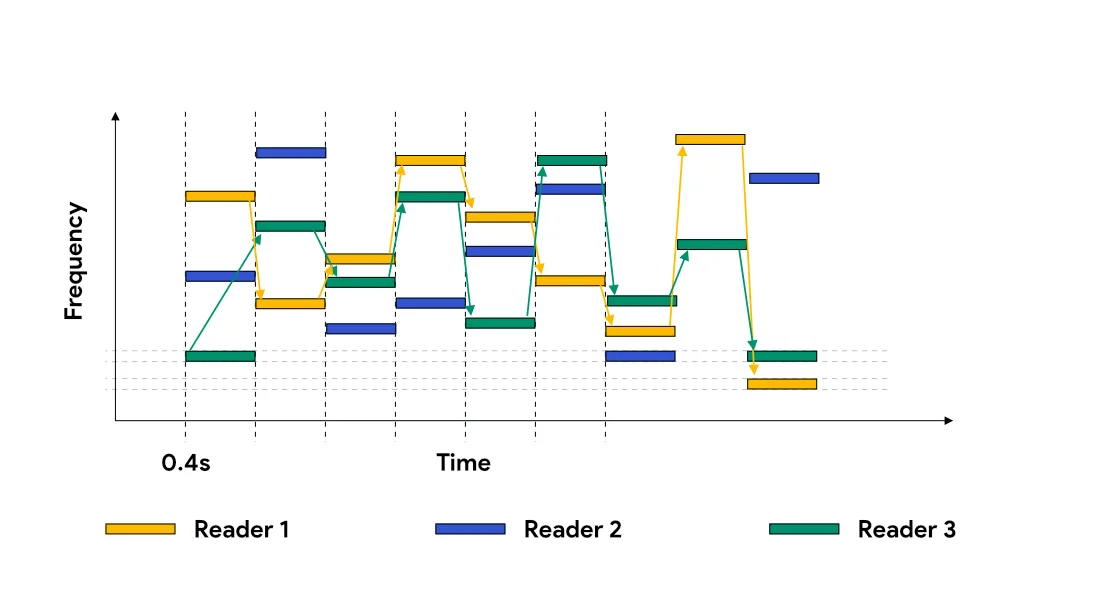
Busy RFID environments require coordination between tags, readers, antennas, space and event timing. Separate tag-to-tag collision from reader-to-reader interference, then test the complete arrangement in the destination environment.
01 / FIELD NOTE
Name the interference problem
Tag-to-tag collision can occur when many tagged items respond together. Reader-to-reader interference is a separate coordination problem that can arise when nearby readers operate across overlapping areas or at the same time. Start with the observed condition, not an assumed cause.
02 / FIELD NOTE
Map the boundary before changing it
Record the intended item path, excluded nearby activity, reader locations, antenna direction, traffic lanes, staged goods and surrounding equipment. A physical separation or shielding discussion is meaningful only when the unwanted observation and the movement that must still be captured are both explicit.
03 / FIELD NOTE
Coordinate operation
Review transmit-power management, frequency or channel coordination, trigger logic and time coordination as one plan. Do not assume that a setting suitable for one reader or region will suit every installation, and do not use an illustrative diagram as a configuration instruction.
04 / FIELD NOTE
Evaluate physical controls in context
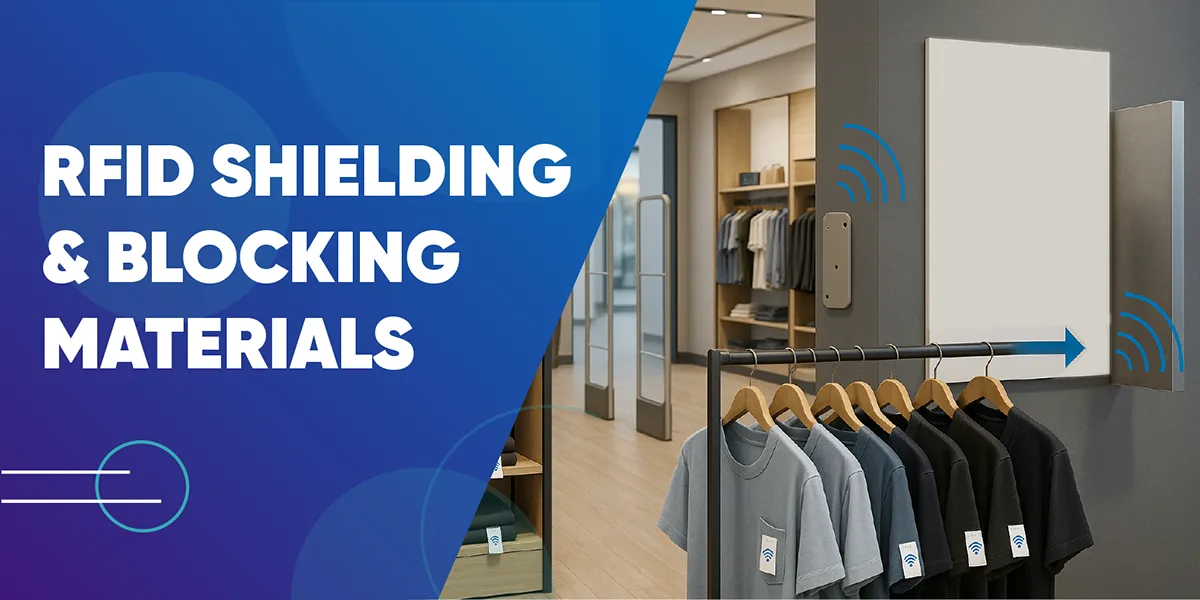
Physical separation, shielding or absorptive treatment may be considered when the site boundary cannot be established through layout, antenna direction, trigger ownership and event rules alone. Material choice, geometry, reader configuration, frequency and site conditions all require representative testing; none of these controls establishes a universal result.
BOUNDARY REVIEW
Turn an interference symptom into a test question
Use the observed condition to choose a first investigation. The matrix is a planning aid, not a material recommendation or a substitute for site testing.
05 / FIELD NOTE
Bound event timing
Define when a reader may observe, which repeated observations belong to one event and how overlapping readers or delayed messages are reconciled. Keep timing notation explanatory rather than treating it as a universal setting, and retain the raw observations needed to explain a decision.
06 / FIELD NOTE
Review the destination region
Confirm the permitted operating modes, regional review, selected equipment combination and installation constraints with current project documentation. A coordination pattern that works in one region or layout is not automatically transferable.
07 / FIELD NOTE
Prove the complete workflow
Test adjacent readers, overlapping zones, simultaneous activity, staged items, reverse movement and duplicate observations with representative samples. Record the configuration, event rules, recovery action and project-specific acceptance evidence before expanding the deployment or changing a physical boundary.
Bring your material, movement, target read and system context to a sample or quote request.
サンプルを依頼